food · 8 min read
The Kyoto Cracker, San Francisco Tea Garden and Mock Trial Behind the Fortune Cookie
Fortune cookies are Japanese-American, baked by Kyoto cracker makers long before they showed up in Chinese restaurants.
By AmpleGuide Editors · Updated October 2026
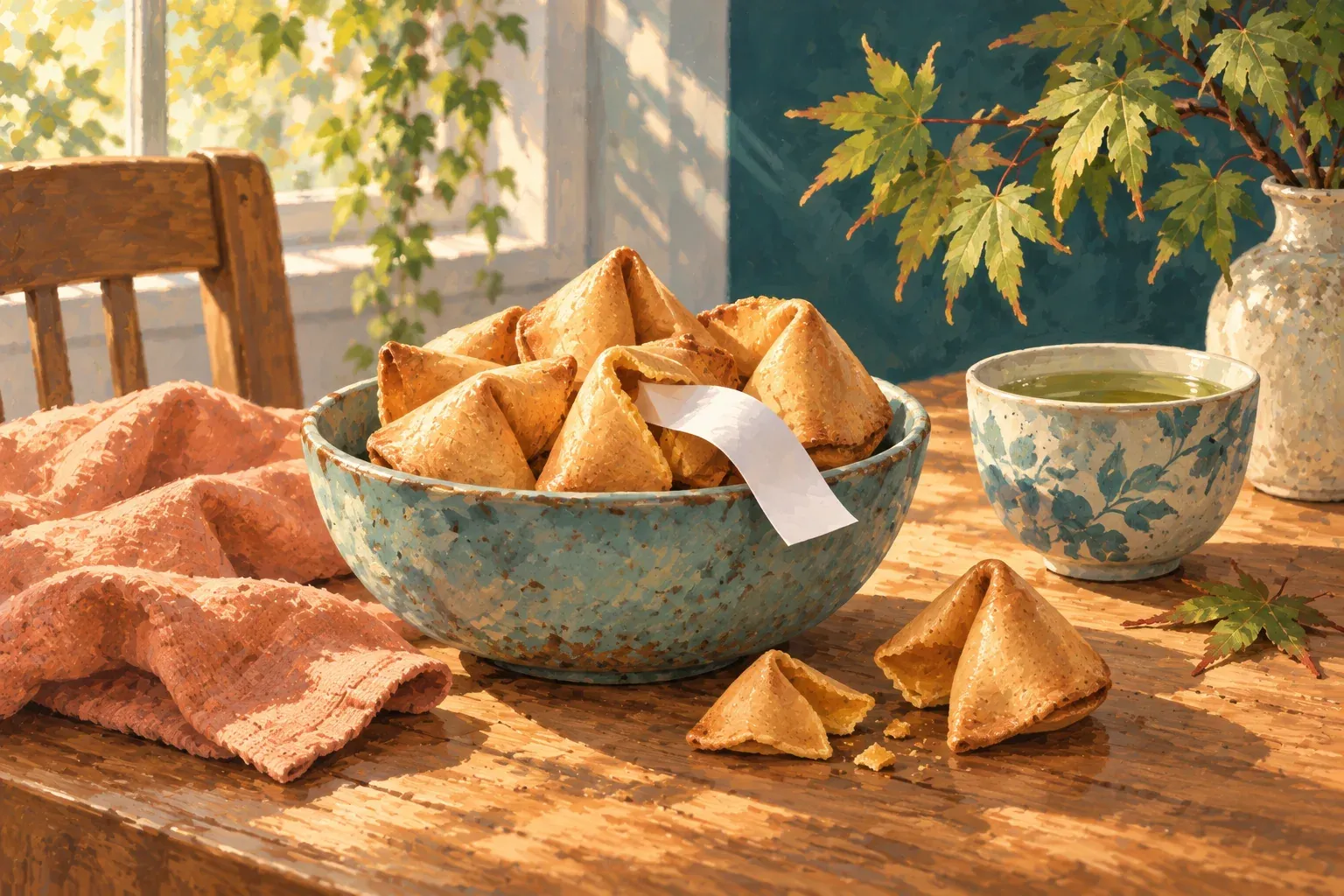
In the cracker shops near Kyoto of the 1870s, you could already buy a folded cracker with a paper fortune tucked into its bend. A storybook print from Japan’s Meiji era shows an apprentice baking these tsujiura senbei, or fortune crackers, in iron molds over a charcoal grill.
The cookie in your takeout bag started in Japan, crossed the Pacific with Japanese immigrants and turned into a Chinese restaurant habit only during World War II. The questions below follow it in that order, so you can skip to the part you came for.
Are fortune cookies really Chinese?
They’re Japanese-American, and you’d have a hard time finding one in China today. Yasuko Nakamachi, a researcher at Kanagawa University, found the crackers still being baked at a generations-old family bakery near a Shinto shrine outside Kyoto in the late 1990s. She then traced them back through Japanese books and prints, including that print.
You probably heard about her work, if you heard about it at all, through Jennifer 8. Lee, who reported it in The New York Times on January 16, 2008, a few weeks before her book The Fortune Cookie Chronicles came out.
China never took to the cookie, and when an American maker tried selling fortune cookies there in 1992, it gave up because shoppers saw them as too American.
How is the Kyoto cracker different?
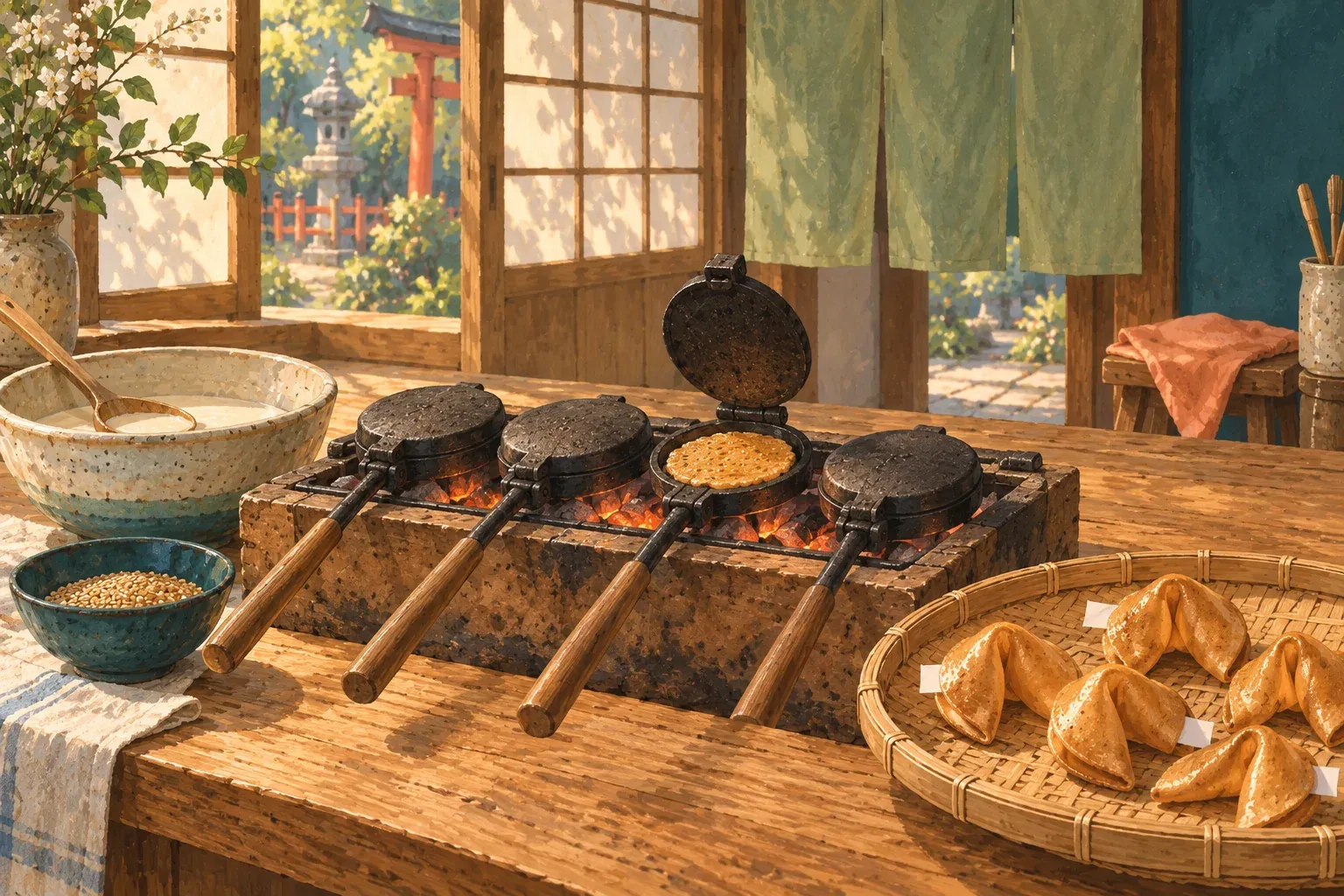
If you held a Kyoto cracker next to a takeout cookie, you’d see the family resemblance right away. The Kyoto version is larger and darker, and it tastes of sesame and miso where yours tastes of vanilla and butter. The bigger difference is where you find the fortune. In Kyoto, the paper slip is pinched into the outside of the bend, so you can read your luck before you take a bite.
The sweet version you know came from San Francisco. Erik Hagiwara-Nagata, a great-great-grandson of Makoto Hagiwara, the man most often credited with the American cookie, told American Heritage magazine that it was made sweet to suit American tastes.
The miso gives the Kyoto cracker a savory edge you won’t find in a takeout bag.
If you’re ever in Japan, you can still buy it near Kyoto’s Fushimi Inari shrine and in Kanazawa, a city on the country’s west coast. The shops near Kyoto shrines tuck one of 23 fortunes into each cracker, The New York Times reported, while Chinese American makers use thousands.
Who served them first in America?
Hagiwara, who took charge of the Japanese Tea Garden in San Francisco’s Golden Gate Park in 1895, gets the credit most often. His grandson George wrote that the family introduced the cookie there with tea sometime between 1910 and 1914. George also said his family was the first to tuck fortunes written in English inside the cookie. Around 1918, the Hagiwaras hired Benkyodo, a Japantown confectionery run by the Okamura family, to bake them.
That shop closed on March 31, 2022, after more than 115 years.
Los Angeles has two rival claims you may run into. Seiichi Kito, who opened a confectionery in Little Tokyo in 1903, said the idea of hiding the fortune where you’d have to crack the cookie to find it was his. David Jung, a Chinese immigrant who ran a noodle company, said he invented the cookie in 1918.
If you’re keeping score, Hagiwara’s claim rests on his grandson’s written account. Still, the Kyoto evidence means none of the three invented the cookie. Each may have helped change the cookie you know. The timeline below runs from the Kyoto print to the newspaper story that brought it to American readers.
| Year | Where | What happened |
|---|---|---|
| 1870s | Kyoto area | Shops sell folded fortune crackers, later shown in a Meiji-era storybook print |
| 1895 | San Francisco | Makoto Hagiwara takes charge of the Japanese Tea Garden |
| 1903 | Los Angeles | Seiichi Kito opens a confectionery in Little Tokyo |
| 1910 to 1914 | San Francisco | Hagiwara’s family serves the cookie at the Tea Garden |
| 1918 | San Francisco and Los Angeles | Benkyodo starts baking for the garden, and David Jung says he invented the cookie |
| 1942 | West Coast | Japanese Americans, bakers among them, are sent to incarceration camps |
| 1983 | San Francisco | A mock court rules for San Francisco |
| 2008 | New York | The New York Times reports Nakamachi’s Kyoto research |
What did the 1983 mock trial decide?
San Francisco won, as you’d guess from where the court sits. The city’s Court of Historical Review stages trials of historical questions for fun, and in 1983 it took up the fortune cookie. Its presiding judge, Daniel Hanlon, was a real judge, which you might not expect from a mock court. He ruled that the cookie came from Hagiwara and San Francisco, not Los Angeles.
The ruling binds no one, and you won’t be surprised that Los Angeles boosters ignored it. You have to admire one exhibit, though, a cookie whose slip read “S.F. Judge who rules for L.A. Not Very Smart Cookie.”
How did they end up in Chinese restaurants?
Fortune cookies most likely moved to Chinese restaurants during World War II. On February 19, 1942, President Franklin Roosevelt signed Executive Order 9066, and more than 120,000 people of Japanese ancestry on the West Coast were forced from their homes into incarceration camps. Two-thirds of them were American citizens.
Many Japanese American businesses closed, including bakeries that made fortune cookies. Nakamachi thinks that’s when Chinese American bakers took over the trade you know today.
The Hagiwara family lost the Tea Garden that year and went to Tanforan, a former racetrack south of San Francisco that the government used as a temporary detention camp. While they were gone, the city renamed the garden the Oriental Tea Garden. The Japanese name, the one you’ll see on the garden today, came back in 1952, but the family was never allowed back.
The usual story about the next step is that soldiers who had passed through California went home after the war and asked for the cookies at Chinese restaurants in their own towns. If that’s right, it helps explain how the cookie you get with your bill became a national habit.
How many fortune cookies are made a year?
The figure you’ll see most often is about 3 billion a year, an estimate from 2008, with nearly all of them baked in the United States. If you divide that by 365, you get more than 8 million a day.
The largest maker turns out more than 4 million a day on its own, so about half the cookies you crack open could come from one company.
Machines do the folding now, and American Heritage describes one industrial fortune cookie machine, nearly 30 feet long, that bakes 8,000 cookies an hour.
George Hagiwara wrote that his family once baked each cracker by hand in iron skillets over a charcoal fire and folded it while it was still warm.
Who writes the fortunes?
Usually somebody on the company payroll, and for about 30 years at the largest American maker, it was Donald Lau, who is also the company’s chief financial officer. He got the job in the 1980s because he spoke the best English in the office when he joined. At his peak he wrote about 100 a year. In 2017 he told Time that his output had dropped to two or three a month.
He handed the job to James Wong, a nephew of the company’s founder. If your recent fortunes sound more like wellness advice than old proverbs, that’s the shift Lau described, since buyers now want new, upbeat sayings.
Do the lucky numbers ever win?
They did once. If you play them, you should know about the drawing that set off a fraud scare. After the Powerball drawing on March 30, 2005, 110 players won second prize, far more than lottery officials expected. Most of them had played the numbers from the same fortune, 22, 28, 32, 33 and 39.
The slip said 40 for the Powerball, and the winning ball was 42, which is the only reason none of them hit the jackpot.
Lottery officials investigated and found no cheating, only one fortune printed for many cookies. The second-prize payouts that night came to about $19 million.