home · 9 min read
Vinegar or Bleach for Cleaning: Only One Is a Disinfectant, and the Two Never Mix
Vinegar is a strong descaler but a weak germ killer. For disinfecting, CDC guidance points to diluted bleach, kept apart from acids.
By AmpleGuide Editors · Updated October 2026
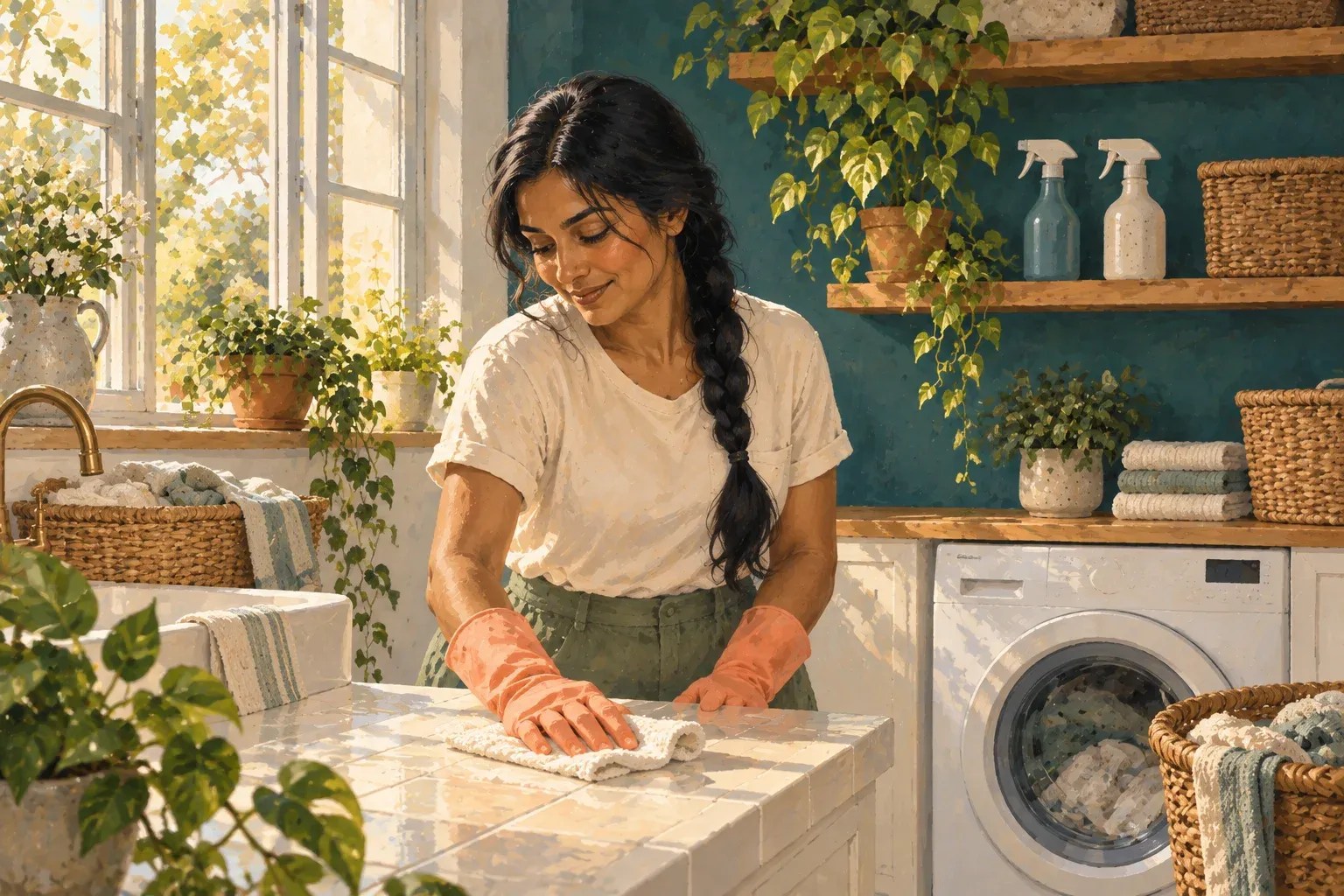
Bleach and vinegar should never go in the same bucket, bottle or sink. Vinegar is an acid, and when you pour an acid into bleach it releases chlorine gas, which burns your eyes, nose, throat and lungs. When CDC researchers surveyed 502 American adults in May 2020, only 35% knew not to mix the two.
Kept apart, both bottles earn their place under your sink, though they do different jobs. Vinegar cleans, while diluted bleach is the one U.S. health agencies count on when you need to kill germs.
Vinegar dissolves mineral scale
White vinegar is acetic acid in water. Vinegar sold in the United States has to contain at least 4% acetic acid, and if you turn over the white distilled kind on most grocery shelves, its label lists 5% acidity.
That acid is very good at one chore in particular. If you have hard water, it leaves a chalky crust of calcium carbonate on your faucets, showerheads, kettle and glass shower door, which vinegar dissolves.
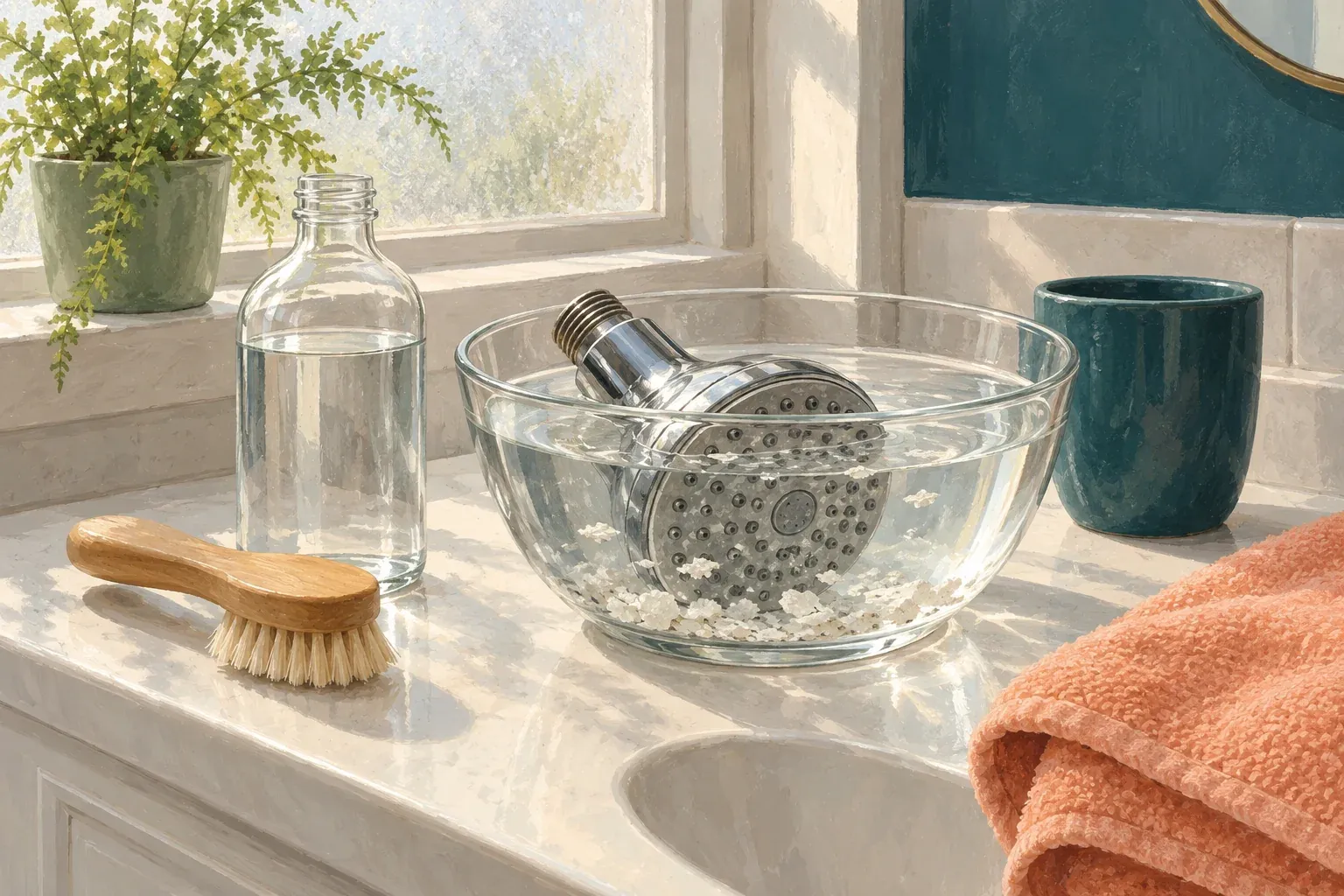
For a showerhead that sprays sideways, a soak in plain white vinegar usually clears the scale. If yours has a plated or colored finish, check the maker’s care instructions first, since some finishes don’t tolerate acid.
The same chemistry is why you keep vinegar off marble, limestone and travertine. Those stones are calcium carbonate too, so the acid etches dull spots into a polished counter or floor.
How well vinegar kills germs
Vinegar’s record against germs is much thinner. A lab study published in 2000 in Infection Control and Hospital Epidemiology tested products for 30 seconds and for 5 minutes against four kinds of bacteria, including Salmonella. Vinegar killed less than 99.9% of Staphylococcus aureus and E. coli, while a household bleach product in the same test killed more than 99.999%.
Converted from those percentages, that means at least 1,000 of every 1 million of those bacteria survived vinegar, and fewer than 10 survived bleach.
Those are limits worked out from the study’s percent killed, not counts anyone took.
Vinegar isn’t helpless, to be fair. Researchers writing in the journal mBio in 2014 found that a 6% acetic acid solution killed tuberculosis bacteria, though it needed 30 minutes of contact. You aren’t going to keep a kitchen counter wet for half an hour. You also won’t find an EPA registration number on a bottle of grocery vinegar.
Bleach is the registered disinfectant
Household bleach is sodium hypochlorite dissolved in water. The CDC says most household bleach you can buy contains 5% to 9% of it.
The EPA registers disinfectants and approves what their labels say, so a bleach sold for disinfecting has an EPA registration number and germ-killing directions printed on it. For disinfecting, the CDC tells you to use regular unscented bleach and to skip any product whose percentage falls outside that range or isn’t listed at all.
You pay for that power in other ways. The CDC’s guideline for disinfection in health care lists the downsides: bleach discolors fabric, corrodes metal at high strength, and gets used up by organic matter such as food residue and grime.
That last point decides the order you work in.
Clean first, then disinfect
The CDC separates the two jobs. Cleaning removes most germs, dirt and impurities from a surface, while disinfecting kills most of the germs left on it. If you pour bleach over a sticky counter, it spends its strength on the grime and has less left for the germs underneath.
Pre-cleaning is step 3 of the EPA’s six steps for using a disinfectant, right after checking the registration number and reading the directions.
If the surface is visibly dirty or the label calls for pre-cleaning, you wash it with soap and water first. Then comes contact time, the stretch when the surface has to stay wet. For the CDC’s diluted bleach, you need at least 1 minute, unless your bottle’s own directions say longer.
Here are vinegar and bleach on each point you’ll care about, using the agency and study figures from earlier in this guide.
| White vinegar | Household bleach | |
|---|---|---|
| What it is | Acetic acid, usually 5% (4% minimum) | Sodium hypochlorite, 5% to 9% |
| Best job | Cleaning: mineral scale, hard-water spots, cloudy glass | Disinfecting clean, hard surfaces |
| Germs killed in a 2000 lab test | Less than 99.9% of S. aureus and E. coli | More than 99.999% of the same bacteria |
| EPA registration number | None on grocery vinegar | On bottles sold to disinfect |
| Contact time | None set for germs | At least 1 minute (CDC) |
| Keep it off | Marble, limestone, travertine | Fabric, colored items, metal at high strength |
| How long a mix keeps | Not applicable | Make fresh daily, weak after 24 hours |
| Never mix with | Bleach | Vinegar, ammonia, any other cleaner |
Why the two never mix
If you mix bleach with an acid or with ammonia, both reactions give off gases you shouldn’t breathe. Since ammonia turns up in some glass and multi-surface cleaners, the CDC tells you never to mix bleach with any other cleaner. A CDC report from June 2020 spelled out the chemistry.
“Mixing of bleach solutions with vinegar or ammonia, as well as application of heat, can generate chlorine and chloramine gases that might result in severe lung tissue damage when inhaled.”
Morbidity and Mortality Weekly Report, CDC, June 12, 2020
Cleaning accidents do happen at home, often with good intentions. Poison centers took 45,550 calls about cleaners and disinfectants from January to March 2020, up 20.4% from 37,822 in the same months of 2019, according to an April 2020 CDC report.
One case in that report began with a woman who filled her sink with a bleach solution, vinegar and hot water to soak her groceries. She noticed a chlorine smell, started wheezing and needed oxygen at a hospital before she recovered and went home.
The CDC’s 2020 survey counted soaking food in bleach as a high-risk practice on its own, and 19% of adults said they had done it.
If you mix them by accident
Leave the room right away and get outside to fresh air. The CDC’s chlorine guidance says to get out of the building when the gas is released indoors, so don’t stay behind to rinse the sink, and keep other people and pets out until it clears.
Call 911 if anyone has trouble breathing or chest tightness, or passes out.
For milder symptoms or questions, the Poison Help line is 1-800-222-1222.
Mixing a bleach solution that works
Follow the directions on your bleach bottle first. Open a window or door before you pour, and put on gloves, plus eye protection if the label calls for it.
If your bottle has no directions, the CDC’s recipe is 5 tablespoons (1/3 cup) of bleach per gallon of room-temperature water, or 4 teaspoons per quart.
Only 23% of adults in the 2020 survey knew the water should be room temperature.
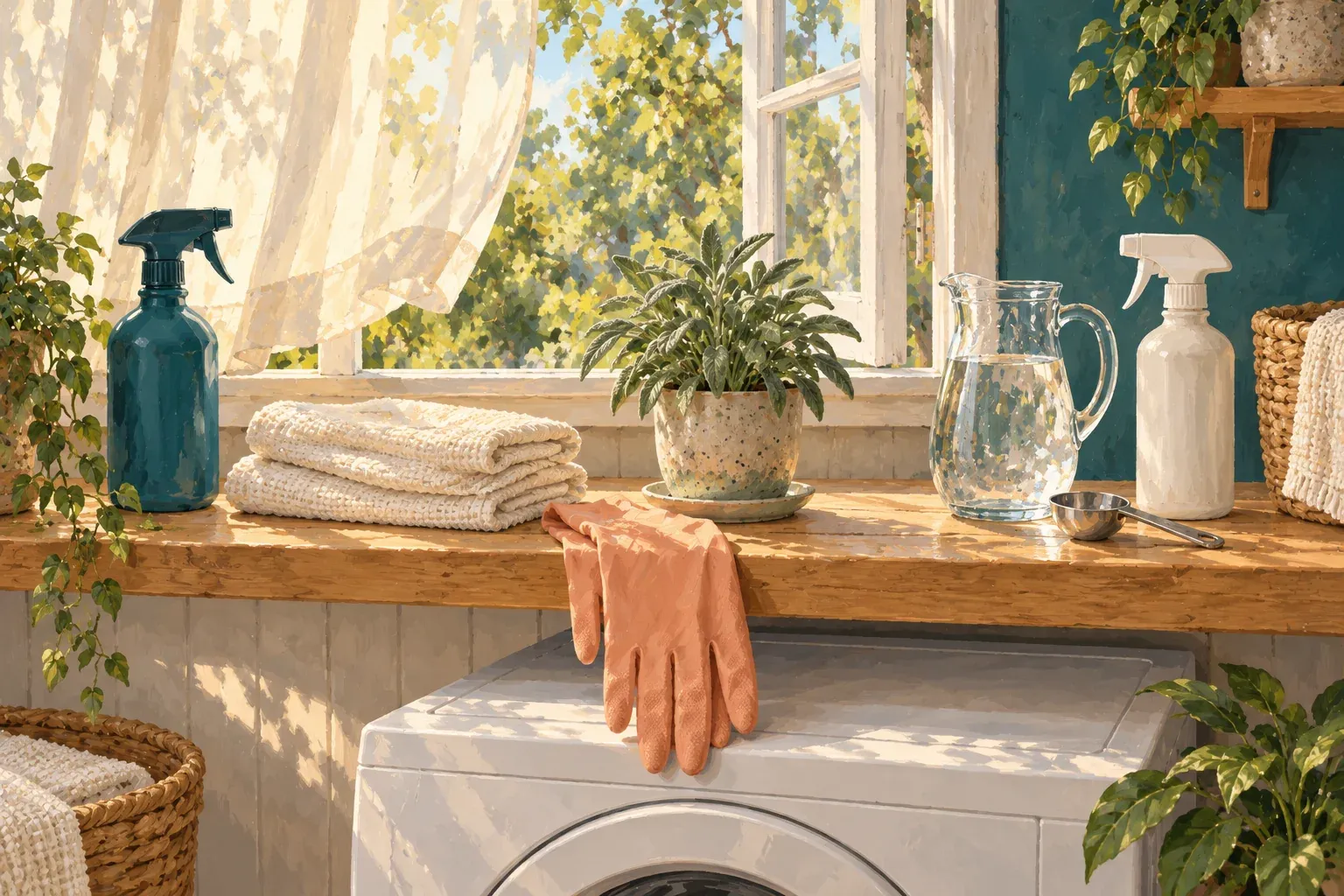
Mix only what you’ll use today. The CDC says a diluted solution loses its punch after 24 hours, and its health-care guideline notes that diluted bleach stored in a closed, opaque container can lose 40% to 50% of its available chlorine in a month. If you find a spray bottle of week-old bleach water in your cupboard, pour it out and start over.
Check the label against List N
The EPA keeps a searchable list of registered disinfectants called List N, built for products it expects to kill the virus that causes COVID-19 when you follow the label. Even outside a pandemic, it’s a quick way for you to look up a bottle under your sink by its registration number.
Find the line that reads “EPA Reg. No.” on your bottle’s label and type the first two sets of numbers into the List N search. The EPA’s own example is 12345-12-2567, which you’d search as 12345-12.
A bottle that sells itself as natural or germ-fighting but has no registration number hasn’t been through that review. While you’re holding the label, read the contact time and the list of surfaces it suits, since those directions beat any general rule, including the ones here.
Which bottle for which day
For a normal week, you don’t need a disinfectant at all. Soap and water handle your counters, tables and floors, and by the CDC’s own definition, cleaning removes most germs along with the dirt. Reach for vinegar when your problem is mineral: a cloudy glass door, a crusted faucet, a kettle with white flakes in it.
Bleach earns its spot when someone in your home is sick or has a weakened immune system, which is when the CDC advises disinfecting. Clean first, then wipe doorknobs, faucet handles, light switches and the toilet flush lever with the diluted solution and leave them wet for the full minute.
A vinegar spray you mixed yourself is not automatically safer because it smells like salad dressing. Vinegar is still an acid that etches stone, and it still makes chlorine gas the moment it meets bleach.
Read the bottle you own
In that same 2020 survey, 58% of adults knew not to mix bleach with ammonia, a much better score than vinegar’s 35%. Store the two on separate shelves to close that gap at home, since bottles kept side by side are easy to grab together and a spray bottle you once filled with one cleaner can carry traces into the next.
Your bleach label answers most of the questions you’ll have after reading this. Pick up the bottle under your sink now and find its sodium hypochlorite percentage and its EPA Reg. No.