home · 8 min read
Slow Bathroom Drains Are Often Just Hair: How to Clear One Without Harsh Chemicals
A slow sink or tub is often a wad of hair and soap scum caught on the stopper, and a plastic strip or plunger can clear it.
By AmpleGuide Editors · Updated October 2026

Pull the stopper out of a slow bathroom sink and you’ll often find the problem wrapped around its stem, a grey rope of hair glued together with soap scum. In a tip quoted in This Old House’s guide to bathroom sinks, Joseph Wood, owner of Boston Standard Plumbing & Heating, says hair and soap scum tend to ball up at the base of the stopper. In the magazine’s guide to snaking drains, its plumbing expert Richard Trethewey says hair is often the main culprit in showers and tubs, too.
That’s good news for you. A clog sitting a few inches below your drain opening usually comes out with inexpensive hand tools, and you can work through them in order, beginning with the gentlest and least messy option.
1. Pull the stopper and clean it
Most bathroom sinks use a pop-up stopper assembly, held in place by a horizontal pivot rod that enters the drain pipe from the back. Clear out your cabinet and set a small bucket and a towel under the pipe, since a little dirty water will drip out.
Find the nut where the rod goes in and unscrew it by hand, or pinch the spring clip if your rod has one instead of a nut. Slide the rod back an inch, and you can lift the stopper straight up out of the sink.
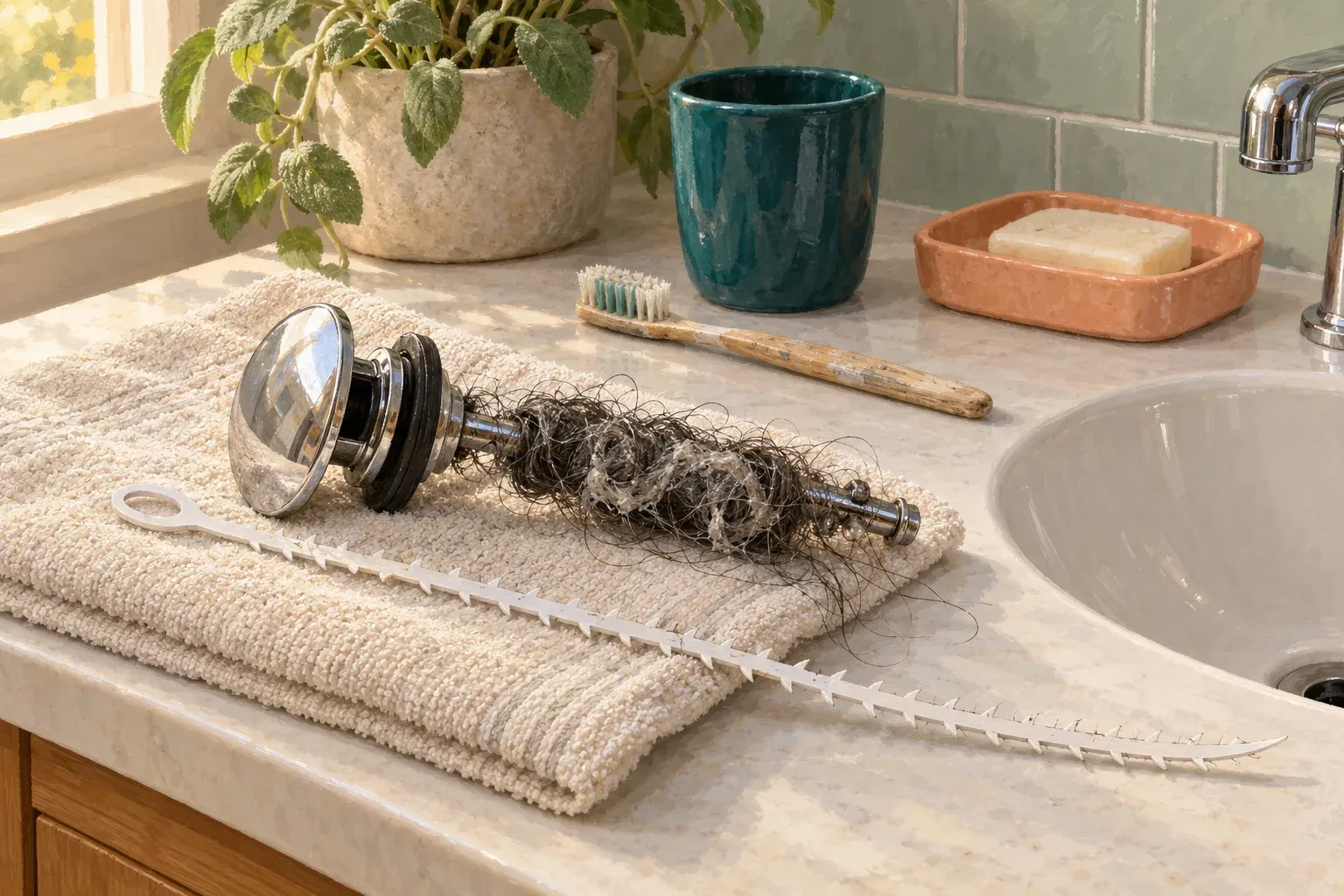
Pull the hair off with a gloved hand or an old toothbrush, then scrub the scum off the stem until you see bare metal. Before you reinstall it, run the tap for a moment with the stopper out.
If the water now drains in a quick swirl, you’re done. Reseat the stopper, slide the rod back through the hole in its stem, and tighten the nut by hand.
2. Fish out hair with a barbed strip
When your sink still drains slowly, the rest of the clump is probably in the tailpiece, the short straight pipe right under the drain. A thin plastic drain strip with barbs along both edges is made for exactly this spot. A separate This Old House piece describes barbed tools like it as particularly effective on hair, which it calls a common problem in bathroom sinks.
Push the strip down the open drain as far as it will go and twist it a few times. Then pull it up slowly so the barbs keep their grip, and wipe it off on a paper towel.
One pass rarely gets everything, so go again until the strip comes up clean. You can use the same strip on a tub once you’ve lifted out the strainer or stopper.

3. Plunge with the overflow plugged
A plunger comes next, and the step most people skip decides whether it works. The small hole near the top of your sink is the overflow, and its channel joins the drain below the stopper. Unless you plug that hole, every push you make sends air up the channel and barely touches the clog.
With the stopper still out, stuff a wet rag into the overflow hole and hold it there. Use a flat cup plunger, the kind without a fold-out flange, and run enough water to cover the cup. Water doesn’t compress the way air does, so it transfers more of your effort directly to the obstruction.
Seat the cup over the drain and pump hard for 20 to 30 seconds, the stretch the sink guide suggests, then pull it off quickly. Repeat a few times if you need to.
For a tub, you’ll want a few inches of water in the bottom and a wet cloth pressed over the overflow plate while you plunge. When the clog gives, the water drops with a gulp.
4. Send a hand auger deeper
If plunging doesn’t move it, the clog sits lower, often in the trap or the pipe that runs into the wall. A hand auger, also called a drain snake, is a flexible coiled steel cable stored in a drum with a crank. The magazine’s all-drains guide says a 25-foot model will handle almost any household clog, which gives you considerably more reach than a bathroom sink requires.
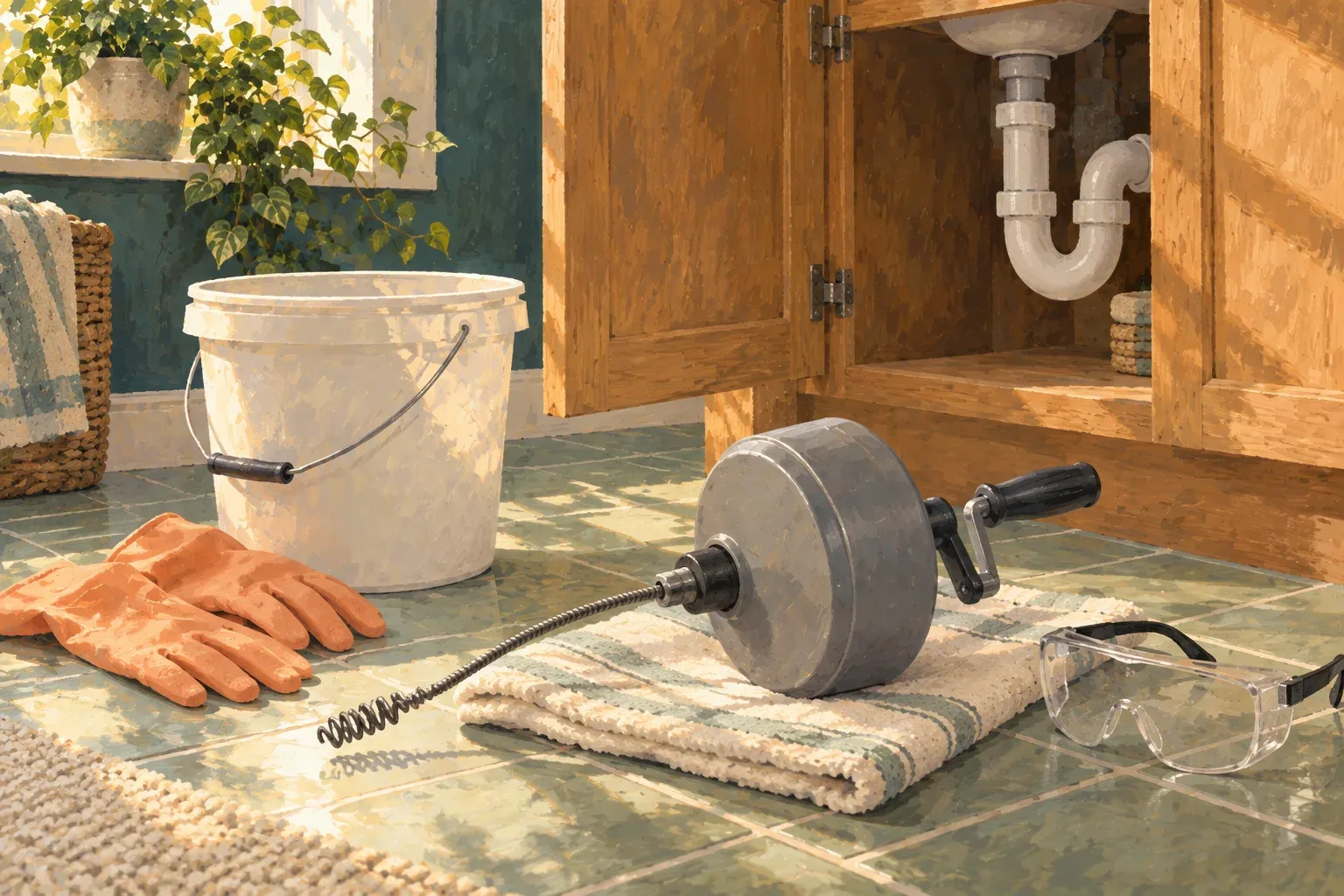
Put on gloves and eye protection first. With the stopper out, feed the cable into the drain while you turn the handle clockwise. When you feel resistance, keep turning and work the cable gently back and forth, then draw it out while it’s still turning. On a tub, the snaking guide feeds the cable through the overflow opening after unscrewing the overflow plate.
Expect a dark plug of hair on the tip when it comes out.
Once your water runs down in a steady stream without backing up in the sink, the line is open.
5. Flush with hot tap water
Finish with a minute or two of the hottest water from your tap to rinse the loosened scum on its way. Skip the kettle, though, especially if the pipe you saw under your sink is white plastic. PVC drain pipe is commonly rated to about 140°F, while water at a full boil is 212°F at sea level.
Your hot tap water should stay under that line. The U.S. Consumer Product Safety Commission urges households to set water heaters to 120°F to prevent scalds, which leaves you roughly 20 degrees of room.
Boiling water has a second problem in a toilet, where the magazine’s toilet guide warns it could crack the porcelain.
Why baking soda and vinegar fizzle
The fizz you see looks like work. Baking soda is a base and vinegar is an acid, and mixing them makes carbon dioxide gas. Poison Control, the service run by the National Capital Poison Center, points out that drains aren’t airtight. The gas escapes up through the drain opening instead of building pressure against the clog, and the center adds that the mixture is unlikely to be strong enough for a tough blockage.
A wad of hair stays right where it was, so you shouldn’t count the foam as a repair.
Skip the caustic drain opener
Chemical drain openers make a poor first step. Poison Control lists their usual ingredients as sulfuric or hydrochloric acid on one side and sodium or potassium hydroxide on the other, and some of them heat up as they work. They’re corrosive, and Poison Control’s safety tips start with goggles, rubber gloves and pouring carefully, close to the drain.
If you already tried baking soda and vinegar, flush the drain with plenty of water before any opener goes in.
They also tend to leave the job half done. In the sink guide, Trethewey says chemicals rarely clear a stoppage and only make a small hole, while a full stoppage needs mechanical clearing.
A failed dose then sits in your trap. Don’t plunge or snake a drain that still holds one, since a single stroke can splash it back at your face.
If you use one anyway, follow the label word for word and never pour in a second product of any kind. Tell any plumber you call what’s in the pipe.
When to call a licensed plumber
A slow sink is a job you can do yourself. Some symptoms belong to someone with bigger machines and a license.
The snaking guide lists several drains clogging at once as a sign of a main-line problem, and it puts foul odors and gurgling drains on its call-a-pro list as well. If your toilet gurgles when the tub empties, or you notice a sewage smell anywhere in the house, it’s time to call a licensed plumber.
Call one, too, if a hand auger doesn’t clear the clog or the drain slows down again within a few days.
Match the symptom to the fix
The table below sorts the common symptoms by where the obstruction probably sits, so you can tell a quick repair from a professional one.
| What you notice | Where the clog likely sits | What to do |
|---|---|---|
| One bathroom sink drains slowly | Stopper base and tailpiece | Steps 1 and 2 |
| Sink stays slow with the stopper clean | Trap or the pipe into the wall | Step 3, then step 4 |
| Tub drains slowly | Hair at the drain, or the trip-lever linkage | Barbed strip, then check the linkage |
| Several fixtures slow at once | Main drain line | Call a licensed plumber |
| Gurgling toilet or a sewage smell | Main line or venting | Call a licensed plumber |
Once your drain runs fast again, the surest way to keep it that way is to stop the hair before it reaches the stopper. The sink guide suggests a drain cover for that, and the simplest one to live with is a little mesh cup you can lift out and tap clean over the wastebasket.