relationships · 9 min read
Making a Close Friend as an Adult Takes About 200 Hours, and Seven Habits Help
Adult friendships grow out of repeated, low-stakes time together, which is why a weekly class beats one big night out.
By AmpleGuide Editors · Updated October 2026

Americans spent about 60 minutes a day with friends in 2003. By 2020 the figure was about 20 minutes. Those numbers come from the American Time Use Survey, and the U.S. Surgeon General put them in a 2023 advisory on loneliness.
A 2021 poll by the Survey Center on American Life found that 12 percent of adults had no close friends, up from 3 percent in 1990.
Those lost minutes matter, since friendship gets built out of time spent together. If you’ve been blaming your personality, take some comfort in that. The seven habits below are ways to add hours with the same few people without forcing anything.
Go to the same place weekly
In 1950, three social psychologists, Leon Festinger, Stanley Schachter and Kurt Back, mapped friendships in Westgate, a housing project for married students at MIT. Residents didn’t choose their apartments. The university assigned them. Even so, most of the friendships people reported were with neighbors a few doors away, and residents whose doors sat near the stairs or the mailboxes made more friends from the floor above.
Their book, Social Pressures in Informal Groups, is about housing, but the lesson travels well. You become friends with the people you keep bumping into. A one-off mixer gives you a room full of strangers you’ll never see again. A weekly class, a volunteer shift or a Tuesday rec league puts the same faces in front of you every week, and by the fourth session you already have something to talk about.
Pick something you’d do anyway
The habit only works if you keep showing up for months, so choose an activity you’d enjoy even if nobody there became a friend. You’re far more likely to stick with a pottery class you like than with a networking night you dread.
A class that runs for 12 weeks gives you 12 chances to see the same people.
Turn acquaintances into plans
Seeing someone at your class counts, but it’s slow. Jeffrey Hall of the University of Kansas measured how slow in a 2018 study in the Journal of Social and Personal Relationships. He surveyed 355 adults who had moved in the past six months and followed 112 first-year college students.
It took about 50 hours together to go from acquaintance to casual friend, about 90 hours to become a friend, and more than 200 hours to become a close friend. Hours spent working side by side counted for less than hours spent hanging out.
A weekly 90-minute class won’t supply that many hours by itself.
What counts toward the hours
The time that moved people up the ladder was leisure, such as hanging out, joking around and catching up on each other’s lives. Students who kept the talk at small talk tended to drift apart. So once you’ve seen someone at the class three or four times, suggest something outside it.
Coffee after the session works, and so does a walk on Sunday. Either one gets the two of you talking about your lives. That’s the kind of time Hall found counted most.
Keep the first plan short and easy to say yes to.
They probably liked you more
After a first conversation, most people drive home replaying the awkward parts. Erica Boothby, Gus Cooney, Gillian Sandstrom and Margaret Clark showed that this replay misleads you in a 2018 paper in Psychological Science. Across five studies, from strangers chatting for 5 minutes in a lab to college roommates followed for several months, people underestimated how much the other person liked them. The researchers named it the liking gap.
“They seem to be too wrapped up in their own worries about what they should say or did say to see signals of others’ liking for them…”
Margaret Clark, Yale University, in the Association for Psychological Science’s release on the study
Ask before you leave
Expect the worry after a first chat, and don’t let it decide whether you ask again. If the conversation felt fine to you, it probably felt good to them, so suggest the next meeting while you’re still together.

Send the second invitation
The first invitation often fails for ordinary scheduling reasons, like a sick kid or a work trip, which makes the second one the real test of whether a plan will happen. If the first answer came with a reason, take the reason at face value, wait a week or two, then offer two specific dates and a place.
How fast the hours come
Each get-together adds only a few hours. At one dinner a month the 200 hours take more than 5 years, while 3 hours a week gets there in about 15 months.
Example: how long Hall’s thresholds take at three paces, counting only hours the same two people spend hanging out.
| Pace | 50 hours (casual friend) | 200 hours (close friend) |
|---|---|---|
| One 3-hour dinner a month | About 17 months | About 67 months |
| 2 hours together every week | About 6 months | About 23 months |
| 3 hours together every week | About 4 months | About 15 months |
If two specific invitations get vague replies, you can let that one rest without any hard feelings. Put your next hour into someone who says yes.
Reach out without a reason
A text that says “saw this and thought of you” feels too small to send. A paper by Peggy Liu, SoYon Rim, Lauren Min and Kate Min, published online in 2022 in the Journal of Personality and Social Psychology, suggests you’re misjudging it. Across 13 experiments with nearly 6,000 people, the ones who sent a short note, a text or a small gift like cookies expected less appreciation than the recipients reported.
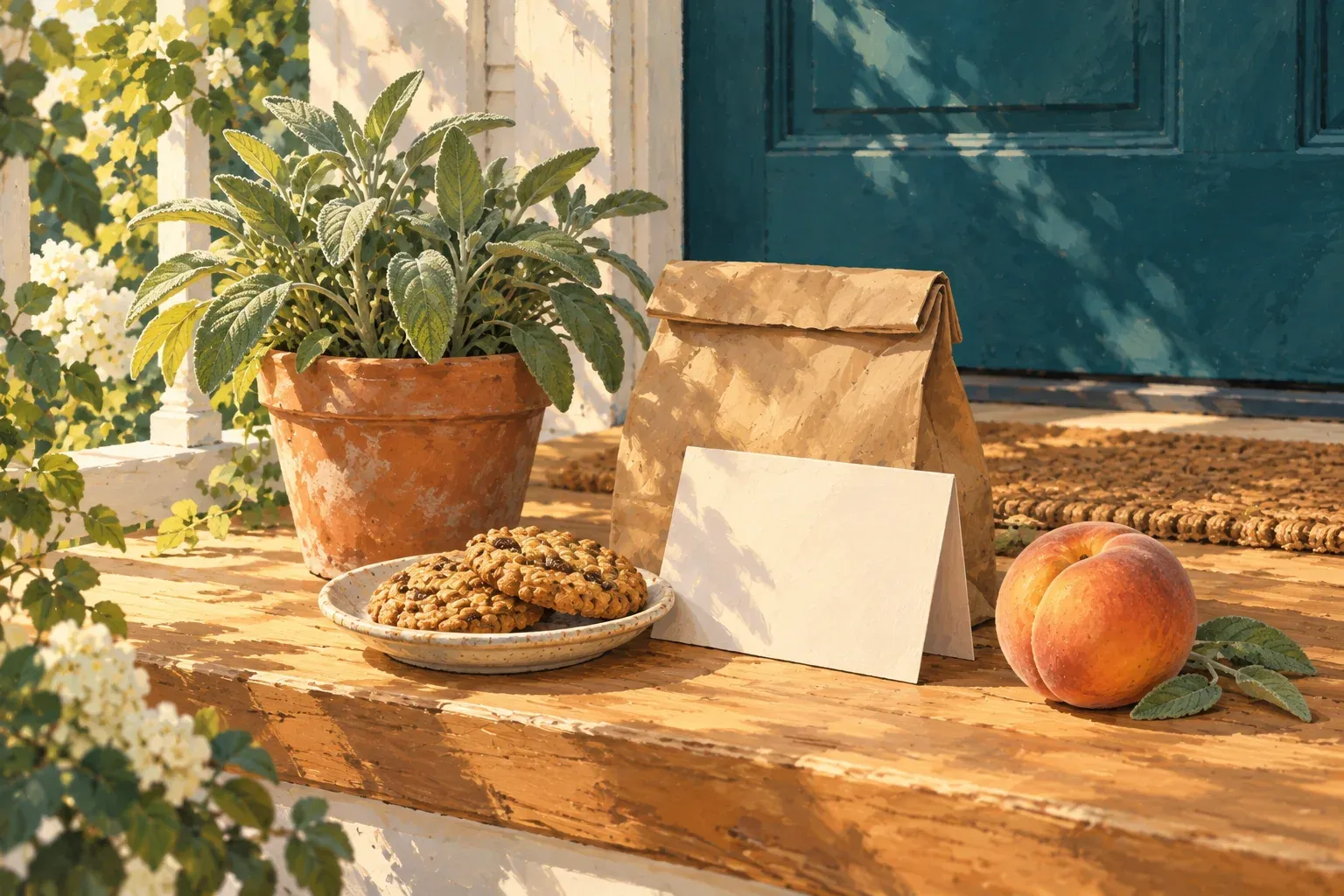
The gap was widest when the message came as a surprise and when the two people weren’t close. That describes almost every message to someone you met at a class last month.
Send the photo of the bakery she mentioned or the link to the trail you talked about. Leave off the question at the end, so the other person doesn’t owe you a reply.
Build a standing routine
Most adult friendships stall in the scheduling, in that back-and-forth of “we should get together” that never lands on a date. With a standing routine nobody has to schedule anything. Every other Saturday morning at the garden, the Thursday walk at 7, and the same booth on the first Monday of the month all repeat without a new round of texts.

A routine also takes the pressure off any single meeting. If this Saturday is flat, there’s another one in two weeks, and the flat Saturdays still count toward Hall’s hours.
Keep a small inner circle
The British anthropologist Robin Dunbar describes social life in layers of about 5, 15, 50 and 150 people, each about three times the size of the one inside it. Roughly, the 5 are the people you’d call in a crisis and the 15 are close friends. The 50 are good friends, and the 150 are meaningful contacts.
In a 2018 piece for the Financial Times, he wrote that people spend about 40 percent of their social time on their inner 5 and another 20 percent on the next 10. That’s about 60 percent of your social time going to 15 people.
That math is freeing. You don’t need 30 close friends, and at 200 hours each you couldn’t keep them anyway. Two or three people moving inward is plenty, as long as your calendar has room for them.
Where your next close friend comes from
Most close friends start in the outer circles, so keep saying yes to the 50 and the 150 as well. This week, write down the two people you’d most like to know better and the next date you could see each one.
If the isolation has turned into a low mood that hangs on for weeks, talk to your doctor or a licensed counselor. Lasting low mood is a health issue, and it’s one doctors deal with every day.
Your next step
Look at what’s on offer near you this month, such as a class, a volunteer shift, a choir or a league, and pick the one that meets every week at the same time. Sign up for the first session within the next two weeks.
Open your calendar and enter it as a repeating event for the next 12 weeks, with a second line under it that says “ask someone for coffee after.”