money · 8 min read
A Penny Cost 3.69 Cents to Make Before the U.S. Mint Struck Its Last One in 2025
Every U.S. coin has a unit cost the Mint reports yearly, and only the dime and quarter still cost less than face value.
By AmpleGuide Editors · Updated October 2026

Each penny the U.S. Mint shipped in fiscal 2024 cost 3.69 cents to make, almost four times what you could spend it for. Those are the Mint’s figures as Coin World reported them. The nickel cost 13.78 cents, and only the dime, at 5.76 cents, and the quarter, at 14.68 cents, still cost less than they’re worth.
That gap ended the penny. On November 12, 2025, Treasurer Brandon Beach struck the last cents made for circulation at the Philadelphia Mint. Those final five coins carry a tiny omega mark, and you’ll never find one in your change.
What each coin costs to make
The Mint calls this number the unit cost and publishes one for every coin you carry, once a year. It covers the metal, the striking, the overhead and the trip to a Federal Reserve Bank, so it’s the full price of putting one coin in your hand.
When a coin costs less than its face value, the government keeps the difference as a profit called seigniorage. When it costs more, the loss lands on the Treasury, which means on you as a taxpayer.
The nickel is worth a fifth of a quarter, 5 cents against 25, yet it costs nearly as much to make, 13.78 cents against 14.68.
The dime and the quarter both come out ahead. A dime costs 5.76 cents to make and spends for 10, while a quarter costs 14.68 cents and spends for 25.
Where the penny’s 3.69 cents goes
CoinNews, a coin-trade news site, listed the Mint’s three line items for each coin. For the penny, 3.00 cents went to the cost of goods sold, which covers the metal blank and the work of striking it. Another 0.66 cents went to the Mint’s general and administrative overhead. Shipping took 0.03 cents.
Add up the two small pieces and you get 0.69 cents, under the penny’s face value. If the coin itself had been cheap to make, the penny could have paid its own way.
The Mint lost about 2.69 cents on every one. With 3.172 billion pennies shipped in fiscal 2024, the Mint reported an $85.3 million loss on the penny that year, plus $17.7 million more on the nickel.
Why the nickel costs so much
Weight and metal decide most of what a coin costs you, and the nickel is heavy on both counts. The nickel weighs 5.000 grams and is copper-nickel all the way through, 75% copper and 25% nickel.
A quarter weighs 5.670 grams and a dime 2.268 grams. Both hide a pure copper core under a thin copper-nickel skin, which brings their nickel content down to 8.33%. That leaves the nickel almost as heavy as a quarter, with three times the share of nickel, the pricier of the two metals. Hold one of each in your palm and you can feel how close their weights are.
Metal prices move these numbers from one year to the next, which is why the penny in your pocket cost the Mint about a fifth more in fiscal 2024 than it did a year earlier.
Between fiscal 2023 and 2024, the penny’s unit cost rose from 3.07 cents to 3.69 cents. The quarter’s jumped from 11.63 cents to 14.68, and Coin World reported that the Mint put most of those increases down to what it paid for metal.
How the penny’s metal changed
The penny’s metal has changed whenever the old recipe got too expensive or too scarce, starting almost before the first one was struck. The Coinage Act of 1792 called for 264 grains of copper in each cent. In January 1793, Congress cut that to 208 grains, and the first 11,178 cents went out that March in a coin about 28 millimeters across, wider than the quarter in your pocket.
| Years | What the cent was made of |
|---|---|
| 1793 to 1857 | Copper, in a large cent |
| 1857 to 1864 | Copper-nickel, in the first small cent |
| 1864 to 1942 | Bronze, 95% copper with tin and zinc |
| 1943 | Zinc-coated steel |
| 1944 to 1946 | Brass from melted shell casings |
| 1947 to 1982 | Bronze again, with the tin dropped in 1962 |
| 1982 to 2025 | Zinc core, 97.5% of the weight, under a copper plating |
For most of that run, you’d have handled some kind of copper coin. The two real breaks came in 1943 and 1982.
The steel cent of 1943
In 1943, the country needed its copper for the war, mostly for ammunition. For that one year, the Mint struck cents from steel with a thin coat of zinc, each weighing 2.702 grams.
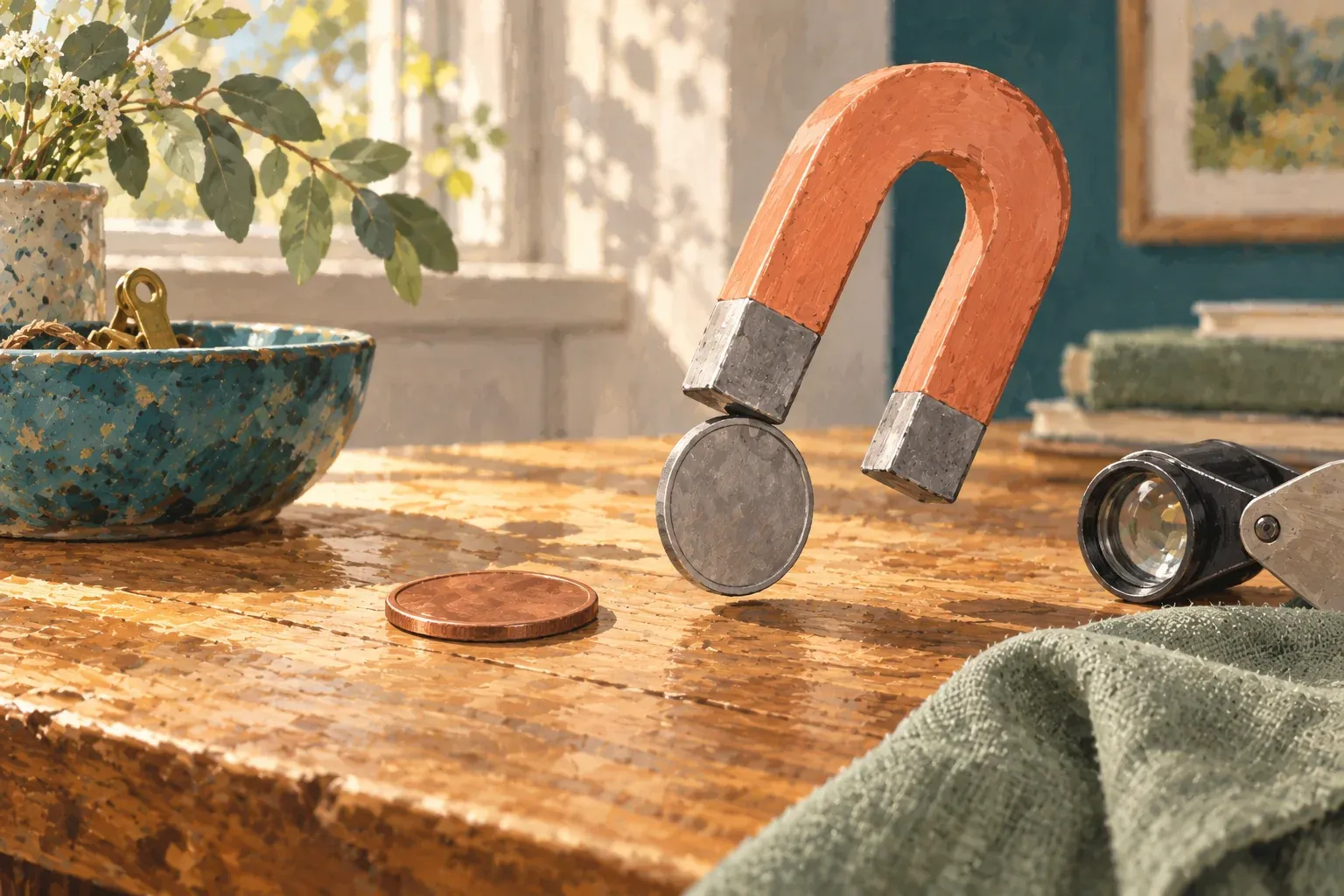
They made poor money. New steel cents were easy to mistake for dimes, and the magnets that vending machines used to catch steel slugs caught them too. The coins were punched from zinc-coated sheet, which left their edges bare to rust.
The steel cent lasted only that one year, because from 1944 through 1946 the Mint melted spent brass shell casings, added copper, and struck cents close to the old bronze.
The 1982 switch to zinc
By the early 1980s, the copper in a 3.11-gram bronze cent was starting to be worth more than a cent. In 1982, the Mint moved to a lighter 2.5-gram coin that is 97.5% zinc, with copper plating making up the other 2.5%.
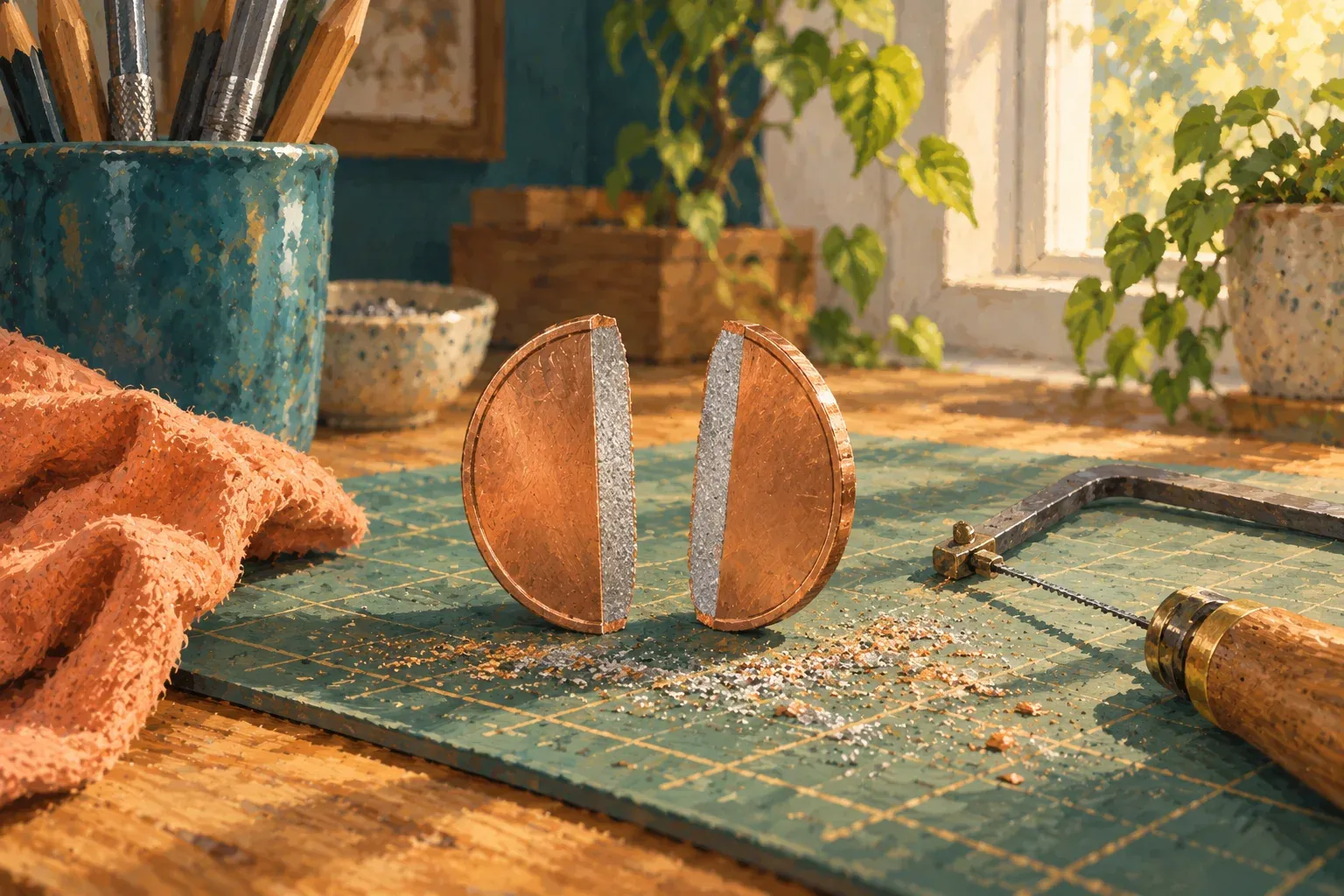
If you have a kitchen scale that reads to a tenth of a gram, you can sort your own pennies by era, 3.11 grams against 2.5.
The switch bought about two decades. Metal prices climbed again, and by fiscal 2006 the penny cost more to make than it was worth. NBC News, quoting the Mint’s annual report in 2025, noted that both the penny and the nickel had stayed above face value for 19 years in a row.
How the last penny was made
In February 2025, President Trump directed the Treasury to stop making pennies. In May, the Treasury placed its final order for penny blanks, the plain metal discs that the presses strike.
Production ended with Beach’s strike in Philadelphia that November, and he said the move would save taxpayers $56 million a year.
The Mint still makes some cents for collectors, but none for your change. In December 2025, an auction house sold 232 three-coin sets of final-year cents for a combined $16.76 million.
Rounding at the register
Your pennies remain legal tender, and the Treasury counts about 114 billion of them still in circulation. If you pay cash at a store that still has pennies, you get exact change as before. A store that runs out of penny change can round your cash total. The Treasury’s guidance asks stores to round the same way in both directions.
If your cash total ends in 1, 2, 6 or 7 cents, it rounds down to the nearest 5 cents. If it ends in 3, 4, 8 or 9 cents, it rounds up. A $4.97 total becomes $4.95, while $4.98 becomes $5.00.
When you pay by card, check or gift card, you still pay the exact amount. Some states have written the rule into law. Vermont’s tax department says the state’s Act 128 of 2026 lets a business round cash totals exactly this way.
Since the rule rounds your total down as often as it rounds it up, the national bill stays tiny. The Federal Reserve Bank of Richmond estimated that rounding would cost American consumers about $6.06 million a year across the whole country.
What isn’t worth the trouble
Melting your pennies for their metal is off the table. Since late 2006, a Treasury rule has barred melting pennies and nickels or exporting them in bulk, with penalties of up to a $10,000 fine and 5 years in prison.
You don’t need to fight the rounding either.
A few cents up on one purchase can come back down on your next, and that $6.06 million is spread across every cash buyer in the country.
The same Treasury rule leaves room for fun. It allows coins to be treated for novelty and amusement, so you can still feed a penny into the souvenir press at a zoo and carry home a flattened oval for your key ring.