food · 9 min read
Frozen Vegetables Keep More Than You'd Think Next to Fresh and Canned
Vegetables frozen soon after harvest held vitamins about as well as fresh ones in university lab tests, and often cost less.
By AmpleGuide Editors · Updated October 2026
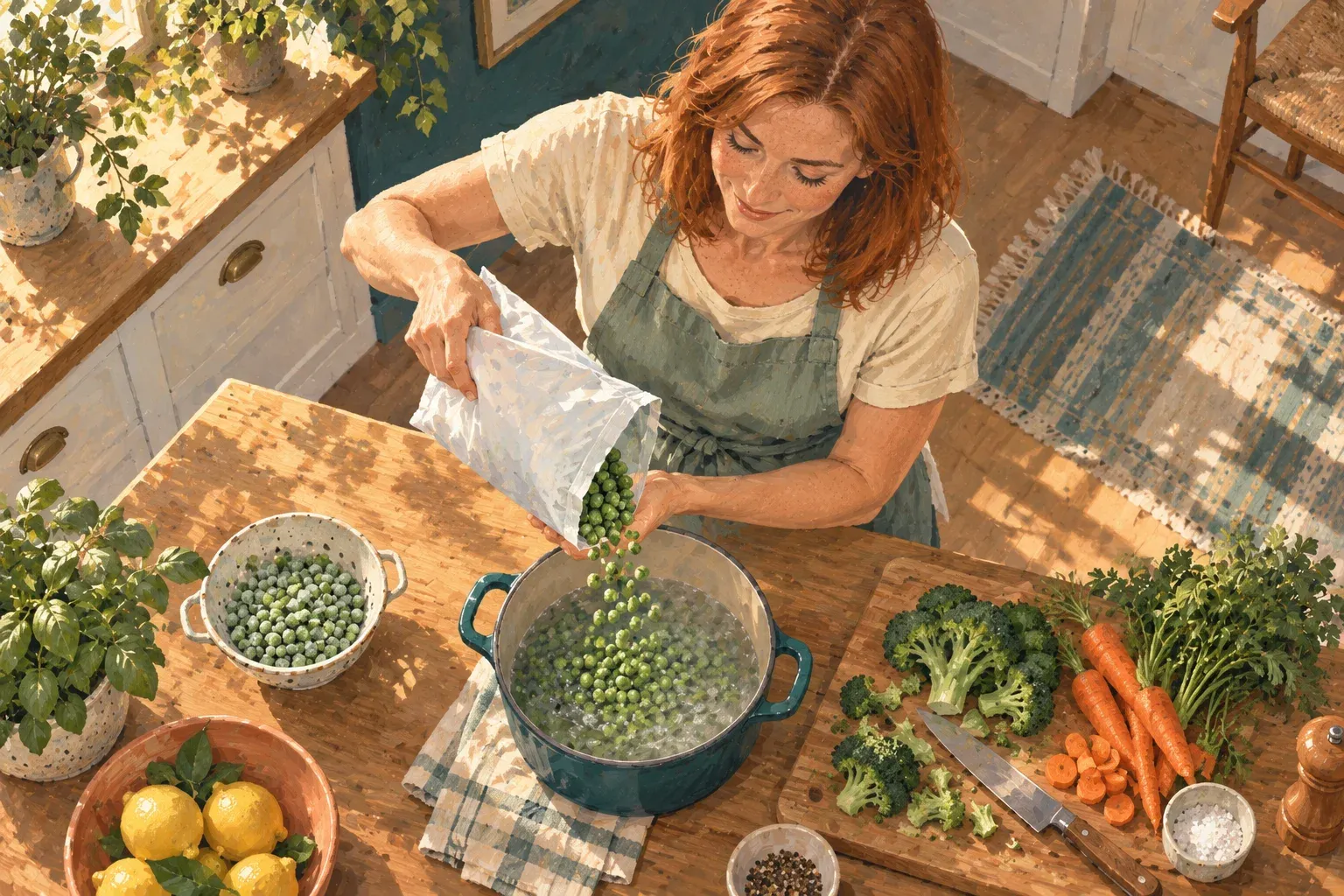
5 days in your refrigerator can undo the head start fresh vegetables have. Researchers spent two years on the question for a 2017 paper in the Journal of Food Composition and Analysis, testing vitamins in produce bought fresh, bought frozen, or bought fresh and chilled for 5 days. That last group matches how you’d probably store it. Most comparisons showed no significant difference, and where one did show up, frozen outperformed the fresh-stored produce more often than the reverse.
Price matters too. USDA figures show frozen vegetables often cost less per serving than fresh, and canned ones cost less still, with one drawback you can read right off the label.
How each kind reaches your kitchen
Fresh vegetables are picked, packed, trucked and shelved, and they’re still alive the whole way. Their cells keep breathing, and their enzymes keep breaking down vitamin C, one of the most fragile nutrients in produce.
That clock keeps running in your crisper drawer. North Dakota State University Extension’s food storage guide gives fresh broccoli and green beans 3 to 5 days in your refrigerator, and leafy greens just 1 to 4 days.
The cans you buy get heated hard after sealing, which costs some vitamin C at the start. After that, the missing oxygen works in their favor. Food scientists Rickman, Barrett and Bruhn reviewed the research in 2007 for the Journal of the Science of Food and Agriculture and found those nutrients fairly stable through canned storage. Frozen produce, by their account, loses fewer nutrients at first and more to oxidation over the months you keep it.
“These findings indicate that exclusive recommendations of fresh produce ignore the nutrient benefits of canned and frozen products.”
Rickman, Barrett and Bruhn, Journal of the Science of Food and Agriculture, 2007
Blanching costs a little up front
Frozen vegetables are blanched before they’re frozen, meaning a quick dip in boiling water or steam that shuts those enzymes down. You pay for that step in vitamin C, but mostly once.
Blanching cut the vitamin C in green beans by 28 percent in a 1998 experiment reported in the Journal of the Science of Food and Agriculture. The beans then lost only 3 to 10 percent more over 12 months in the freezer, while beans frozen without blanching lost 97 percent or more within a month.
In 1996, broccoli told a similar story in Food Chemistry, where blanching took 41 to 42 percent of the vitamin C and a year in the freezer took another 15 to 18 percent. That broccoli kept slightly more vitamin C at -30°C than at -20°C (-4°F).
So most of what you give up with a frozen vegetable goes in the first few minutes at the plant, not during the months in your freezer.
What the lab tests found
The 2017 study covered eight kinds of produce: broccoli, cauliflower, corn, green beans, green peas, spinach, blueberries and strawberries. Its authors measured vitamin C, provitamin A and folate, and in most comparisons they found no significant difference among fresh, frozen and fresh-stored samples.
They wrote that their results don’t support the common belief that fresh food has significantly more nutritional value than frozen.
A team at the University of California, Davis, reached a similar answer in 2015. Writing in the Journal of Agricultural and Food Chemistry, they compared refrigerated and frozen storage of eight fruits and vegetables, testing each at three points in storage. Vitamin C came out the same for 5 of the 8 and higher in the frozen samples for the other 3.
Where frozen falls short
Frozen doesn’t win every round, and you shouldn’t expect it to. The UC Davis work found less beta-carotene in frozen peas, carrots and spinach than in fresh ones.
Results split down the middle in a 1992 comparison from the Journal of Food Quality. Green beans frozen for 16 weeks had about twice the vitamin C of beans put through a simulated store run of up to 7 days. Frozen broccoli had only about half as much as its store-fresh match.
How you cook matters as much as which bag or bunch you buy. Boiling sent 60 percent of spinach’s vitamin C into the cooking water, according to spinach research published in 1999 in the Journal of Agricultural and Food Chemistry.
You’ll keep more of it in the dish if you steam, microwave with a splash of water, or drop frozen peas straight into a soup you’re going to eat broth and all.
What a cup costs in each form
USDA’s Economic Research Service prices vegetables per cup equivalent, the amount that counts as one cup toward federal eating guidelines once you’ve trimmed and cooked it. In its 2023 figures, frozen undercut fresh for every vegetable in the chart except carrots, and canned came in cheapest for three of the four.
If you cook spinach, fresh cost $1.93 per cup equivalent, against $1.19 frozen and $0.96 canned. Corn ran $1.42 fresh, $0.69 frozen and $0.68 canned. Green beans cost $0.87 fresh, $0.72 frozen and $0.54 canned.
Carrots flip the pattern. A cup of fresh carrots, cooked, cost $0.39, while frozen cost $0.66 and canned $0.65, which makes fresh the cheapest form in this comparison.
Part of what you pay for fresh goes in the trash. ERS assumes that 22 percent of a broccoli head’s weight is tough stalk and trimmings, one reason fresh heads worked out to $1.32 per cup equivalent while frozen broccoli cost $1.00. Bagged fresh florets, which ERS counts as all edible, came to $1.05.
If you peel and slice the stalk instead of tossing it, you claw some of that back.
Fresh, frozen and canned side by side
Green beans come in all three forms and turn up in every data set above, so they make a fair test case for what you put in your cart. Two rows come from USDA’s food loss estimates and its nutrient database, explained below.
| Green beans | Fresh | Frozen | Canned |
|---|---|---|---|
| Price per cup equivalent, 2023 | $0.87 | $0.72 | $0.54 |
| Vitamin C | Highest at harvest, then falls | Drops in blanching, then holds | Drops in canning, then holds |
| Prep | Wash, trim and cut | Cook straight from the bag | Drain and rinse |
| How long it keeps | 3 to 5 days in the fridge | 3 to 6 months in the freezer | Years unopened, 3 to 4 days opened |
| Texture and best uses | Crisp; roasting, salads, stir-fries | Softer; stir-fries, soups, sides | Soft; casseroles, stews, soups |
| Sodium per 100 grams | 6 mg raw | 3 mg | 268 mg, or 2 mg with no salt added |
| Share lost at the store | About 22% | About 6% | About 6% |
Salt is the canned vegetable’s real drawback, and rinsing helps less than you’d hope. In USDA’s FoodData Central, drained canned corn drops from 205 to 163 milligrams of sodium per 100 grams after a rinse under the tap, and canned peas go from 273 to 231, so a no-salt-added can is the surer fix.
Waste starts at the store
Fresh vegetables lose a lot before you ever pick them up. Beyond the green bean figures in the table, USDA’s food loss estimates put store losses for fresh spinach at about 18 percent, mostly produce that wilts, bruises or gets culled from the display.
At home, the difference is how long you have. North Dakota State’s guide says to keep store-bought frozen vegetables frozen 3 to 6 months, and to keep an opened can’s contents covered in your fridge for 3 to 4 days.
Leafy greens give you the least time, at 1 to 4 days in the fridge.
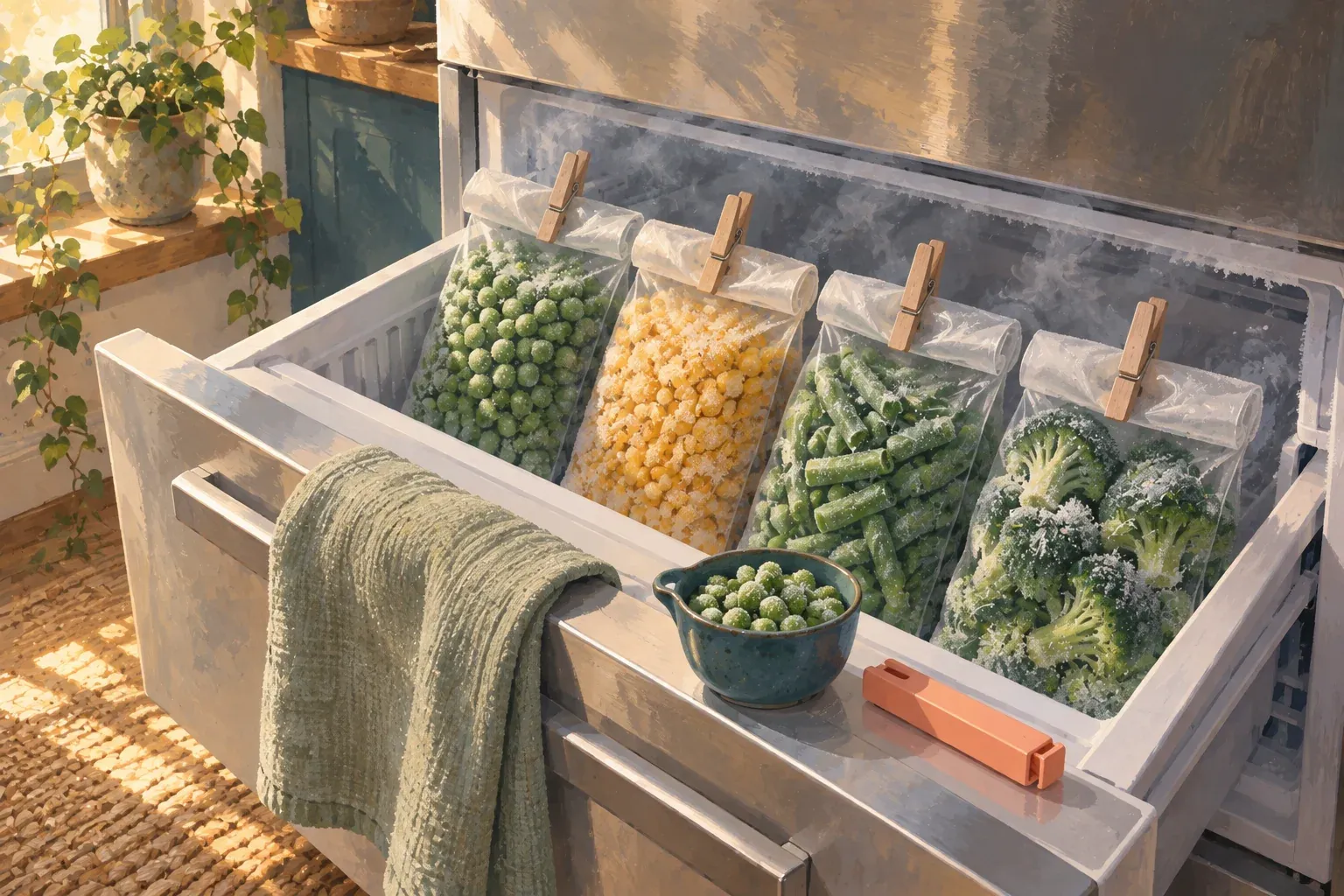
A frozen bag also lets you take one cup and put the rest back, which you can’t do with a bunch of fresh spinach once it starts to slump.
Which one fits how you cook
If you shop twice a week and cook most nights, fresh earns its place for anything you want crisp, such as salads, roasted broccoli or a quick stir-fry. Buy only what you’ll cook within those 3 to 5 days.
If your week is less predictable, frozen covers the gaps. Freezing softens vegetables, so frozen green beans won’t snap like fresh ones, but in soups, fried rice or a side tossed with butter, you’ll hardly notice.
Canned vegetables suit your pantry shelf and long-simmered dishes like chili, stews and casseroles, where a soft texture doesn’t matter. Pick the no-salt-added cans and season to your own taste.
Six checks before checkout
- Plan fresh vegetables for your next 3 to 5 days of meals, and buy greens last.
- Choose plain frozen vegetables without sauce for the nights you won’t shop.
- Buy your carrots fresh, since that’s the cheaper form.
- Turn each can over and look for “no salt added” on the label.
- Keep the broccoli stalk and slice it into your pan with the florets.
- Steam or microwave instead of boiling, or add frozen peas straight to your soup.