food · 8 min read
Seven Cast-Iron Skillet Rules You Can Drop, Starting With Never Using Soap
Seasoning holds up better than the old rules suggest, so mild soap, a short tomato sauce and a steel spatula all leave it intact.
By AmpleGuide Editors · Updated October 2026
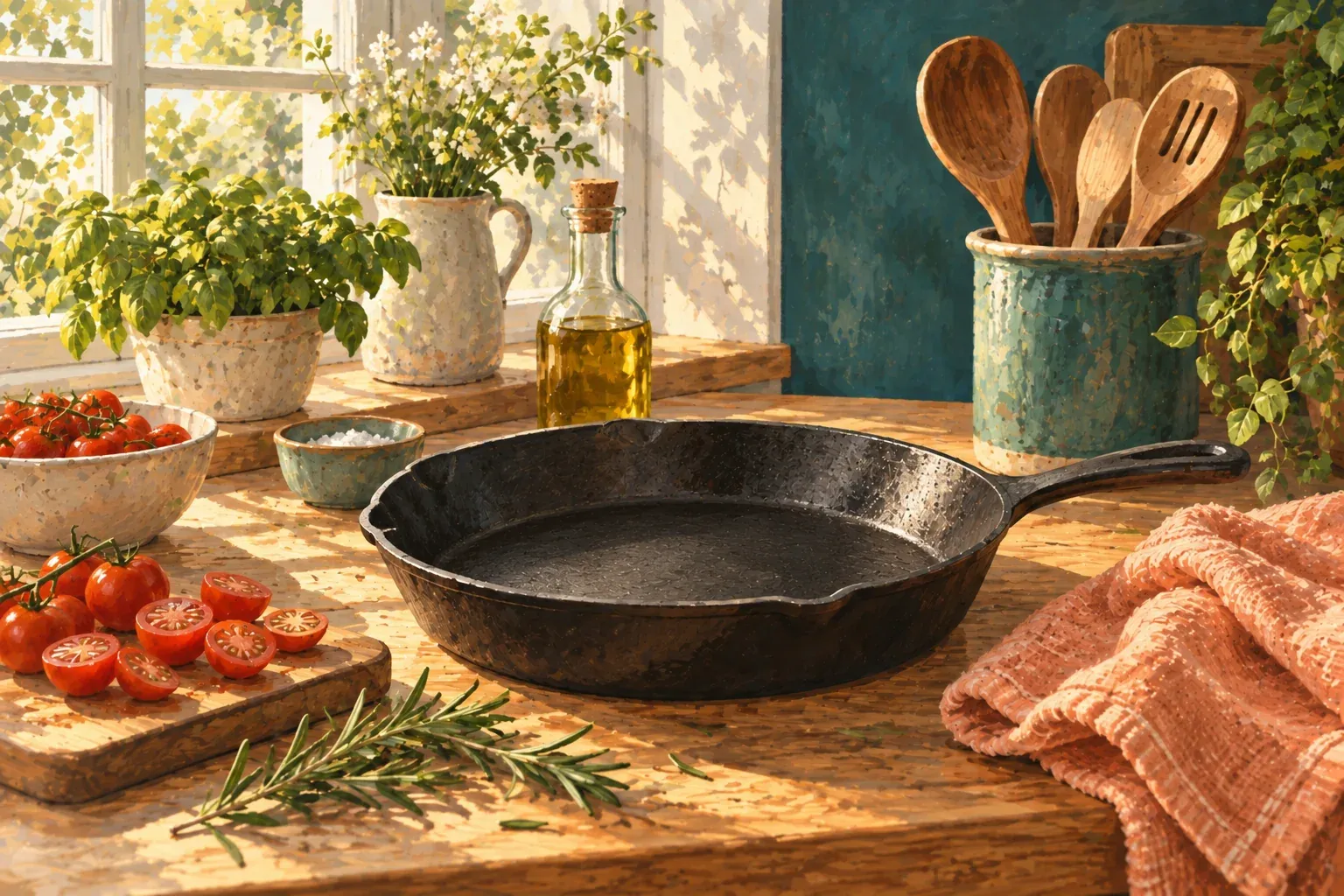
The black finish on a cast-iron skillet isn’t paint. It’s cooking fat that high heat has turned into a hard, plastic-like film, bonded to the bare iron underneath.
Cooks call that film seasoning, and most of the rules you’ve heard about your skillet are really rules about protecting it. Those rules treat the film as far more fragile than it is, which means you can drop most of them once you know what each one gets wrong.
| The rule | What happens | What to do instead |
|---|---|---|
| Never use soap | Dish soap lifts grease and leaves the bonded film alone | Wash briefly, then dry it at once |
| Never cook tomatoes | In an America’s Test Kitchen test, tasters found no metal flavor at 15 minutes and noticed it at 30 | Keep acidic simmers short |
| It heats evenly | Iron spreads heat less than a quarter as fast as aluminum | Preheat longer than you think |
| Metal utensils ruin it | A spatula scrapes off stuck food and loose flakes | Use a smooth-edged spatula freely |
| A rusty pan is done for | Rust sits on the surface of solid iron | Scrub it off, then reseason |
| Reseason after every use | A thin wipe of oil on a warm pan is enough | Save the oven for repairs |
| It adds a lot of iron | The amount swings with the food and the cooking time | Don’t count on the pan for it |
1. Dish soap won’t strip seasoning
The no-soap rule dates from a time when soap meant something harsher. Sodium hydroxide, sold as lye, is the chemical behind traditional soap making, and it dissolves fats. It’s also common in oven cleaner, a standard way to strip a pan bare.
The dish liquid by your sink is a different product. It’s a synthetic detergent, a blend of surfactants made to lift grease off a surface, and a short wash leaves the baked film in place.
Extension services still split on this. Mississippi State University Extension and NC State’s extension center in Polk County, North Carolina, both tell you to skip soap. A 2024 University of Maine Cooperative Extension guide says there’s no clear consensus, and that a large amount of soap is what harms the pan.
Maine has it right.
How to wash it
Rinse your pan while it’s still warm, use a drop of soap and a brush or soft sponge, then rinse again. The step you shouldn’t skip is drying. The NC State guide warns that cast iron left in a wet sink “will rust very quickly,” so towel it off and set it on a low burner for a minute.
2. Short tomato sauces are fine
Acid does react with iron, and that part of the rule is real. A 1986 study in the Journal of the American Dietetic Association found that acidity was one of the things that raised how much iron moved from the pan into the food.
What matters is how long you let the acid sit. In a side-by-side tomato sauce test, America’s Test Kitchen’s tasters couldn’t detect any metallic flavor after 15 minutes of simmering, but after 30 minutes they noticed a metallic taste in the sauces cooked in both cast-iron pans.
Where the line falls
You can make a quick pan sauce, splash in wine to lift the browned bits, or blister tomatoes over high heat without a second thought.
A pot of sauce that bubbles for two hours on a Sunday belongs in enameled or stainless cookware. If you do let one go too long, America’s Test Kitchen says you may have to throw out the food, but you can simply reseason the skillet.
3. Cast iron spreads heat slowly
Cast iron has a reputation as the steady, even pan, and it’s half earned. Iron is a slow conductor. The Engineering ToolBox metals table lists cast iron at 52 watts per meter-kelvin, against 236 for pure aluminum and 401 for copper.
In plain terms, heat spreads through your skillet less than a quarter as fast as it spreads through aluminum. The spot over your burner gets hot first, and the rim catches up later.
What cast iron does well is hold heat. Gram for gram, aluminum stores more heat than iron, 0.91 kilojoules per kilogram per degree against 0.46. Your skillet makes up for it with weight, since it’s roughly 2.5 to 2.9 times as dense and skillet walls are thick.
That mass is why your hot skillet doesn’t cool much when a cold steak lands in it.
How to preheat it
Give your pan several minutes over medium heat before food goes in, and shift it around if the burner is smaller than its base.
When you need the whole surface hot, for cornbread or a big batch of potatoes, put the skillet in the oven while the oven preheats.
4. Metal spatulas are safe
This rule came over from nonstick pans, where a metal edge can gouge a thin factory coating that doesn’t grow back. Seasoning is different. You build it from the same fat you cook with, so every time you sear or fry, you add a little more.
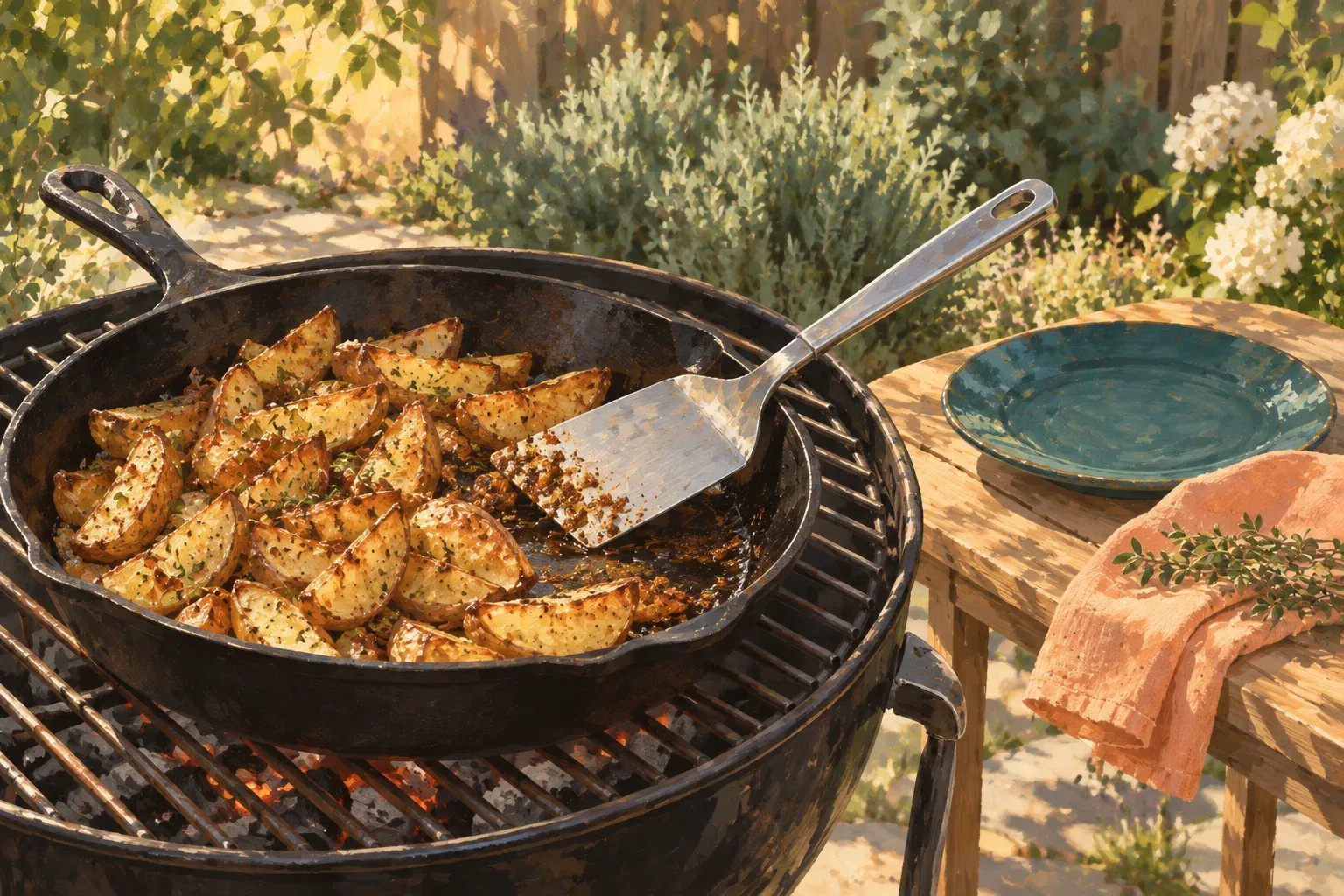
Pick a flat, smooth edge
A smooth, flat steel spatula is often the best tool you can use in cast iron. It scrapes up stuck food and knocks off loose, carbonized flakes while the bonded film beneath stays put.
If you scrape a patch down to dull gray metal, cook a few fatty meals in the pan and it will darken again.
5. A rusty pan can be saved
Rust sits on the surface, and the pan underneath is solid iron. Mississippi State University Extension says you can often remove light rust with a wet towel and kosher salt. For heavier rust, it suggests soaking the rusted area in vinegar for no longer than 15 minutes at a time. NC State’s Polk County guide uses equal parts water and white vinegar and says to check the pan every 15 minutes.
Keep your soaks short. Vinegar is an acid, like the tomatoes in item 2, and once the rust is gone it starts on the iron underneath.
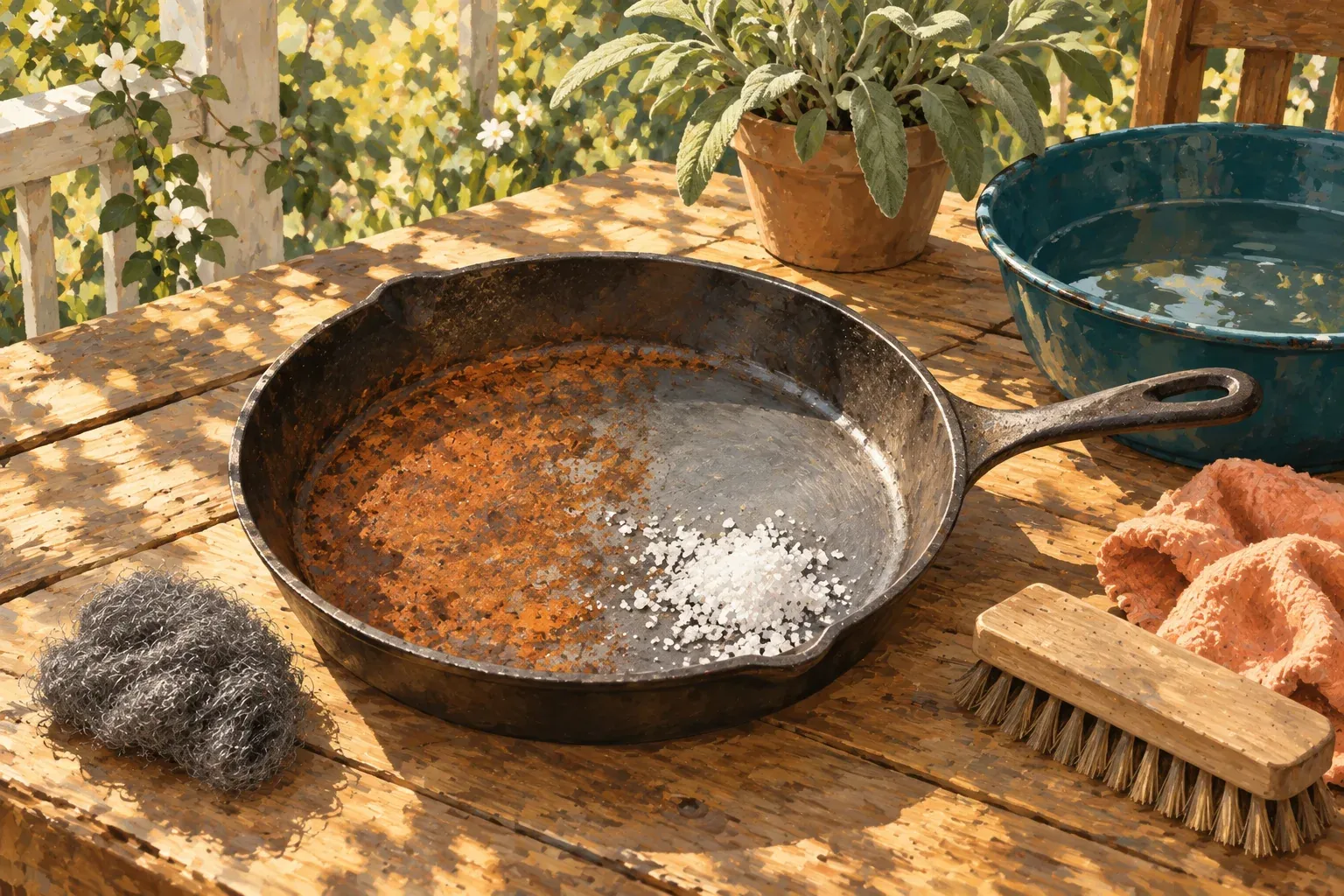
Scrubbing rust off
Work the rust with salt and a wet rag first, then step up to fine steel wool for the stubborn spots. Wash the pan, dry it on a burner, and give it a full oven seasoning before you cook in it again.
6. A thin oil wipe is enough
A full oven reseason is a repair job, for bare spots, rust or a pan you’ve just stripped.
After an ordinary wash, the University of Maine guide says to put your dry pan on low heat, add a small amount of neutral oil and spread it over the inside with a paper towel. Wipe until the pan looks almost dry, since oil left in a puddle tends to bake into a sticky patch.
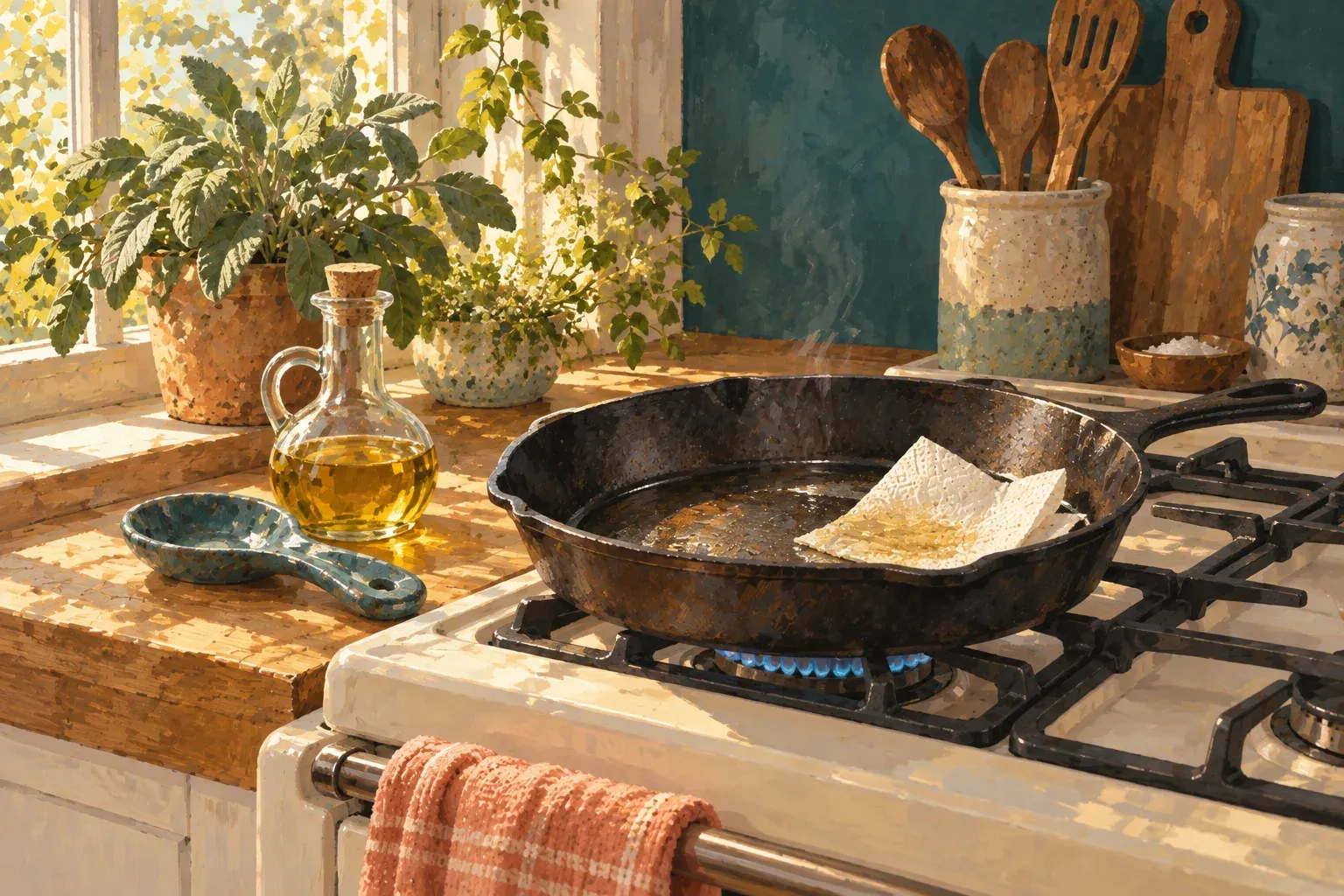
When the oven is worth it
For a full reseason, Mississippi State bakes the oiled pan at 350°F for 3 to 4 rounds, Maine at 450°F for 3 to 5 and Polk County at 550°F for usually 3, each round lasting 1 hour. Maine adds that the pan goes in upside down, and that 200-degree spread among three university offices tells you there’s no single correct number.
Pick a temperature your oven reaches comfortably, keep your coats thin and open a window.
7. The extra iron is unpredictable
Your pan does add iron to food, but the amount varies widely. In the 1986 study, Helen Brittin and Cheryl Nossaman cooked 20 foods in iron and non-iron pots, three times each. Most of the foods, 90 percent of them, came out with significantly more iron from the iron pan. Acidity, moisture and cooking time changed how much.
A 1991 follow-up in the Journal of Food Science, by Cheng and Brittin, cooked applesauce and spaghetti sauce 50 times in the same iron skillet. Through all 50 rounds, the sauces cooked in iron still had more iron than the same foods cooked in non-iron pans.
Why you can’t count on it
You can’t predict the amount at home. The University of Maine guide says it depends on the food, the cooking time and the condition of the pan, so treat the iron as a side effect.
Most of what your skillet needs fits on one burner. You need a quick wash, a minute of heat to dry it and a thin wipe from the bottle of cooking oil.