home · 7 min read
A Space Heater Can Out-Spend Your Fridge: What Every Appliance Costs to Run
Appliance energy costs come down to watts, hours and your local electric rate, a sum you can do with the sticker on the back.
By AmpleGuide Editors · Updated October 2026
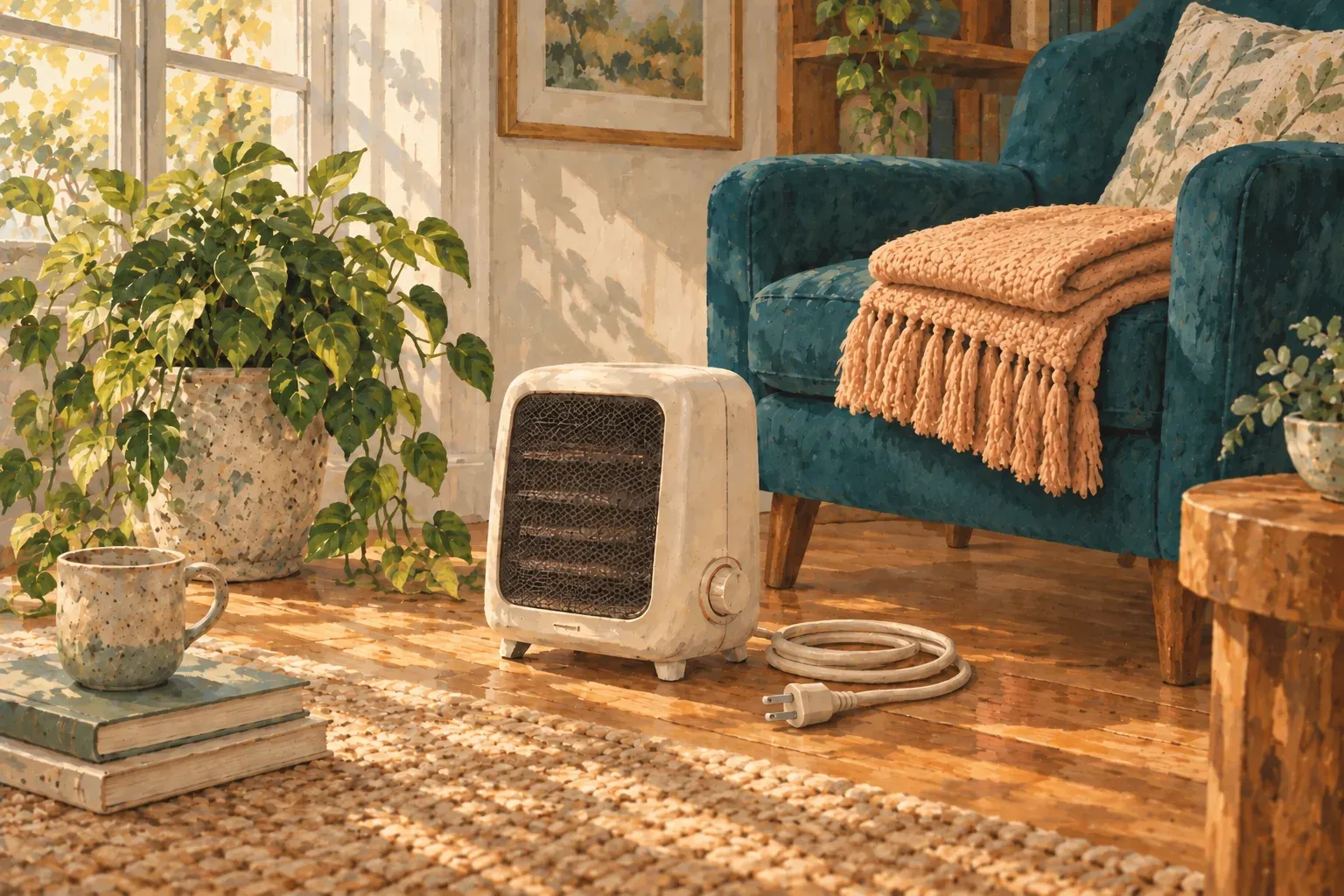
Every appliance in your home runs on the same arithmetic. You take its watts, multiply by the hours it runs, divide by 1,000 to get kilowatt-hours, then multiply by what your utility charges for each one.
At today’s national average rate, a year of typical use runs from about $32 for a handful of gadgets on standby to about $262 for a 1,500-watt space heater used through the winter.
The space heater sits at the top of that range, above the refrigerator and the clothes dryer. It draws half the watts of a dryer, and you can check the figure for any appliance on the sticker on its back.
Three numbers make the sum
The Department of Energy’s Energy Saver guide spells out the formula. Its own example is a 200-watt window fan running 4 hours a day for 120 days, which comes to 96 kilowatt-hours, or kWh, a year.
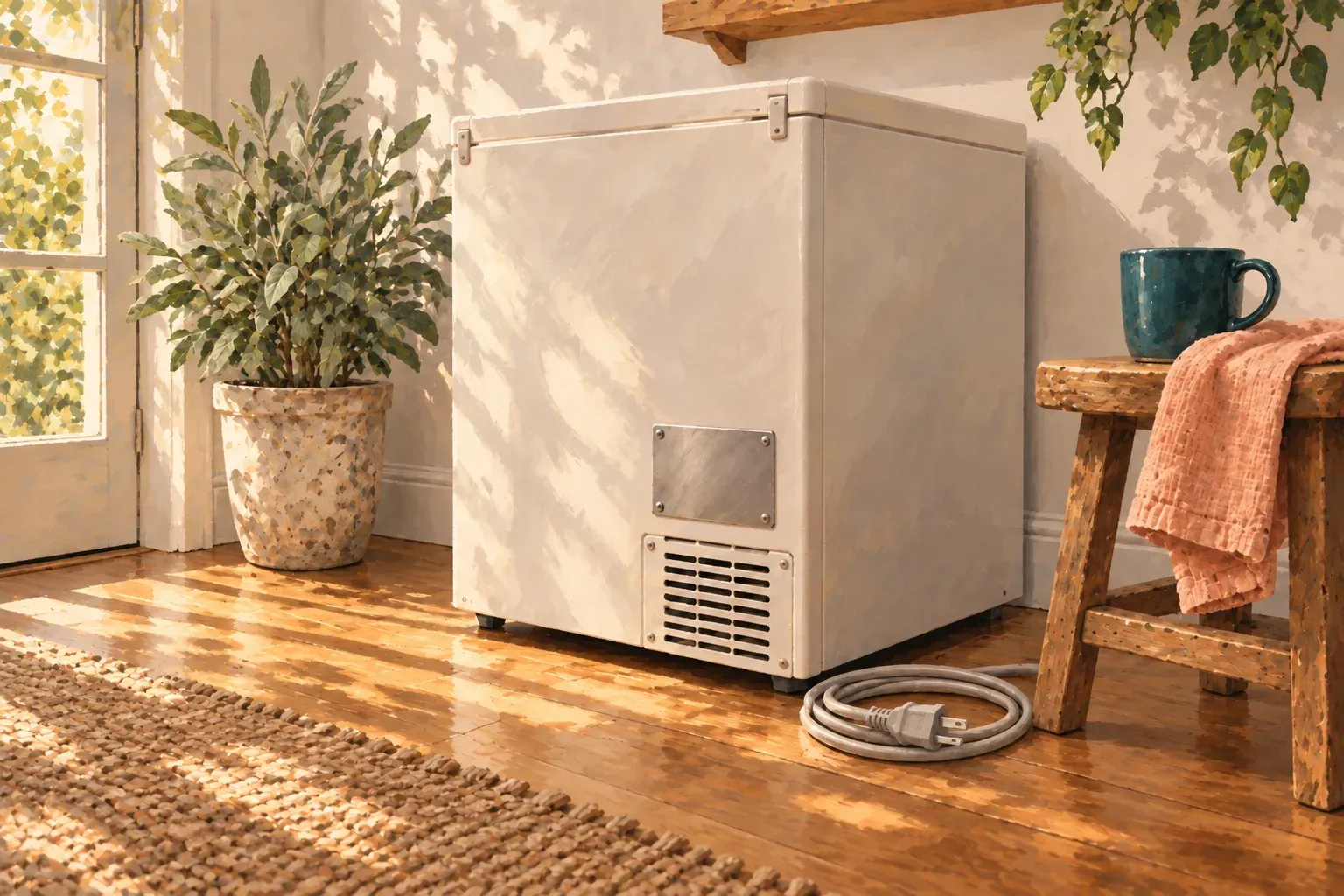
You need three numbers. The watts are printed on a spec plate or sticker, usually on the back or bottom of the appliance or near where the cord leaves it. The hours are your own honest guess, and the rate is on your electric bill as a price per kWh.
If you don’t have a bill handy, you can use the national average that the U.S. Energy Information Administration publishes every month. From January through July 2026, American homes paid 18.19 cents per kWh, up from 17.01 cents over the same months of 2025.
Every figure below uses that 18.19 cents unless it names a state.
Hours matter more than size
A clothes dryer can pull 3,000 watts, twice what a space heater draws. Yet in the chart below, the heater costs you $262 a year against the dryer’s $106. You might run the heater 8 hours a night for 120 winter days, while your dryer works 45 minutes a load, 5 loads a week.
Your refrigerator makes the same point from the other side. It’s plugged in for all 8,760 hours of the year, but its compressor cycles on and off, and a modern fridge might use 500 kWh, or $91, in that time. A 1,500-watt heater burns through the same 500 kWh in about 42 evenings of 8 hours each.
The rest of the list holds fewer surprises. A 1,000-watt window air conditioner through a summer comes to $131, a dishwasher using about 1 kWh a load comes to $47, and a 100-watt TV comes to $33. Ten devices drawing 2 watts each on standby, at $32, cost you nearly as much as the TV.
So when you guess at a cost, spend your effort on the hours.
Your state sets the price
EIA’s figures for January through July 2026 put Hawaii at 46.28 cents per kWh and California at 33.25 cents, while Idaho paid 12.96 cents and North Dakota 12.36 cents.
Hawaii’s rate is about 3.7 times North Dakota’s, so the same heater that costs you $178 a year in North Dakota would cost you $666 in Hawaii. Even California’s $479 sits closer to Hawaii than to Idaho’s $187.
Example: a 1,500-watt space heater run 8 hours a day for 120 days, at each place’s average residential rate for January to July 2026.
| Place | Rate per kWh | Heater’s yearly cost |
|---|---|---|
| Hawaii | 46.28 cents | $666 |
| California | 33.25 cents | $479 |
| U.S. average | 18.19 cents | $262 |
| Idaho | 12.96 cents | $187 |
| North Dakota | 12.36 cents | $178 |
Rates also differ between utilities inside one state, so the price on your own bill beats any average. Per hour, that heater costs you about 27 cents at the national rate and about 69 cents in Hawaii.
Seasons and peak hours shift costs
Which machines you run depends on the month. In EIA’s 2020 Residential Energy Consumption Survey, air conditioning used 19% of the electricity American homes consumed, the largest single use, while space heating and water heating took 12% each.
A time-of-use plan changes the rate itself.
On one of these plans, your utility charges more per kWh during a peak window, often late afternoon into early evening, and less overnight. You can lower what the dryer and dishwasher cost by running them after the peak, though your heater or air conditioner tends to run right when the peak price applies.
Standby adds up slowly
Standby power is what a device draws while it’s switched off but still plugged in, keeping a clock, a remote sensor or a charger ready. In 1997, Alan Meier of Lawrence Berkeley National Laboratory estimated that the average American home leaked about 50 watts this way, roughly 5% of its electricity.
At today’s average rate, those 50 watts would cost you about $80 a year.
Meier also proposed a one-watt target for standby, and the International Energy Agency adopted it in 1999. Newer electronics mostly draw a watt or two, which is why 10 of them cost you about $32 a year in the cost chart. To find your own standby loads, look for anything that stays warm, glows or shows a clock while it’s off, such as a charger, a game console or a TV box.
EnergyGuide dollars run low
The yellow EnergyGuide label lets you compare one model with another. The Federal Trade Commission requires it on refrigerators, dishwashers, room air conditioners and several other appliances under 16 CFR Part 305, and it shows the yearly kWh from a federal test along with an estimated yearly cost. Older units often use more power, so you can see what a replacement would draw.
Trust the kWh number more than the dollar figure.
Since January 2023, the FTC has had makers figure that cost at 14 cents per kWh, or 13 cents for room air conditioners, well under the 18.19-cent average. A fridge labeled at 500 kWh shows you $70 a year but costs $91 at today’s national rate and $231 in Hawaii. Multiply the label’s dollars by about 1.3 for a national-average figure.
Space heaters carry no EnergyGuide label at all, so for yours, the watts on the plate are all you have.
Give space heaters 3 feet
Since space heaters top the cost chart, it’s worth placing yours well. The U.S. Fire Administration says to keep anything that can burn at least 3 feet from the heater and to plug it directly into a wall outlet, never an extension cord. The Consumer Product Safety Commission adds power strips to that list.
If the heater’s plug or cord gets hot, the CPSC says to disconnect the heater and have it repaired. A hot wall outlet is a job for a licensed electrician.
Upgrades that rarely pay off
A new appliance you buy only to cut your bill rarely pays for itself. If a new fridge used 200 kWh a year less than your old one, it would save you about $36 at the national rate, and a working fridge usually earns its keep until the day it breaks.
A pricier space heater won’t make heat any more cheaply. Electric resistance heaters turn almost all the power they draw into heat, so every 1,500-watt model costs the same 27 cents an hour at the national rate, whatever its shape or price tag.
A time-of-use plan isn’t worth signing up for if your big loads can’t move out of the peak window.
Your own numbers are easier to find than any average. The rate is on your bill, the hours are yours to estimate, and the watts are stamped on that small metal plate on the back, a few inches above where the cord comes out.